
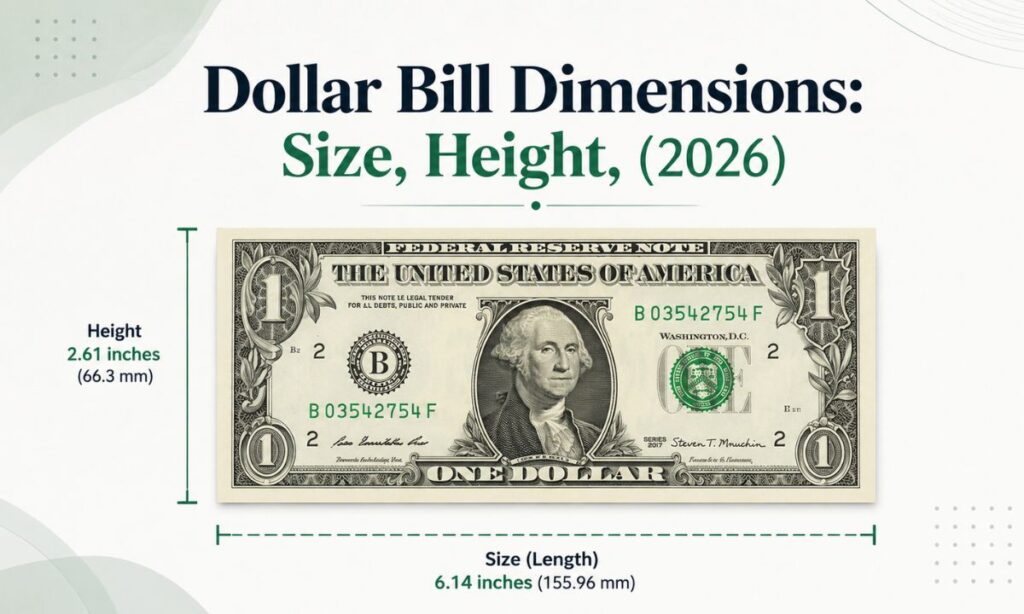

Ever pulled out a dollar bill and wondered, “how big is this thing, exactly?” You are not alone. Whether you are building a custom wallet, designing a display case, or just curious, knowing the exact dollar bill dimensions matters more than people think.
A standard U.S. dollar bill measures 6.14 inches long and 2.61 inches wide. In metric, that is 156 mm x 66.3 mm. Thickness is just 0.0043 inches, which is thinner than two sheets of printer paper.
This guide covers everything, exact sizes, denomination comparisons, stack heights, historical changes, and some genuinely surprising facts.
Let’s get into it.
Dollar Bill Dimensions in Different Units
Not everyone measures in inches.
If you are working on a school project, a craft, or setting up a bill display, having the numbers in different units saves time.
A dollar bill is 6.14 inches long and 2.61 inches wide in imperial. Switch to centimeters and you get 15.6 cm x 6.6 cm. In millimeters, the official spec from the Bureau of Engraving and Printing is 156 mm x 66.3 mm.
The weight of a dollar bill is exactly 1 gram, or 0.035 ounces. That means one thousand dollar bills weigh exactly one kilogram. Handy if you ever need to ship a large amount of cash and want to calculate postage.
Quick Reference Table
| Feature | Imperial | Metric |
| Length | 6.14 inches | 156 mm |
| Width | 2.61 inches | 66.3 mm |
| Thickness | 0.0043 inches | 0.109 mm |
| Weight | 0.035 ounces | 1 gram |
Source: Bureau of Engraving and Printing (BEP), U.S. Department of Treasury. These are the official U.S. currency dimensions verified against BEP published specs. Slight variation can happen with worn or heavily circulated notes.
Are All Dollar Bill Dimensions the Same?
Here is something that surprises most people.
Every single U.S. bill, from the $1 to the $100, is exactly the same physical size.
It does not matter what denomination you are holding.
One Size Fits All U.S. Currency
The Federal Reserve made this decision on purpose. Uniform bill size means ATMs, vending machines, and cash registers never need to adjust for different denominations. That saves billions in machine calibration and production costs every year.
This is actually unique to the United States. Most other countries use different sizes for different denominations. The UK, the EU, and Canada all vary their banknote dimensions by value so people can tell amounts apart by touch.
The American approach trades accessibility for efficiency. It keeps paper money dimensions consistent across the entire supply chain. And it means your wallet works perfectly no matter which bill you pull out.
Historical Dollar Bill Sizes
Before 1929, American money was much bigger. Old notes were nicknamed “horse blanket currency” because they barely fit in a normal wallet. Some measured up to 7.4 x 3.1 inches, nearly 30% larger than what we carry today.
In 1929, the Treasury Department standardized everything. Smaller bill measurements cut production costs and made bills last longer in circulation. Banks could also store significantly more in the same vault space.
That single change modernized American currency overnight. The standard dollar size we know today, 6.14 x 2.61 inches, has stayed locked in for nearly a century. Wars, recessions, and presidents have come and gone, but the size never changed.
Also Read:Monster Can Dimensions: Size, Height (2026)
Dollar Bill Dimensions by Denomination
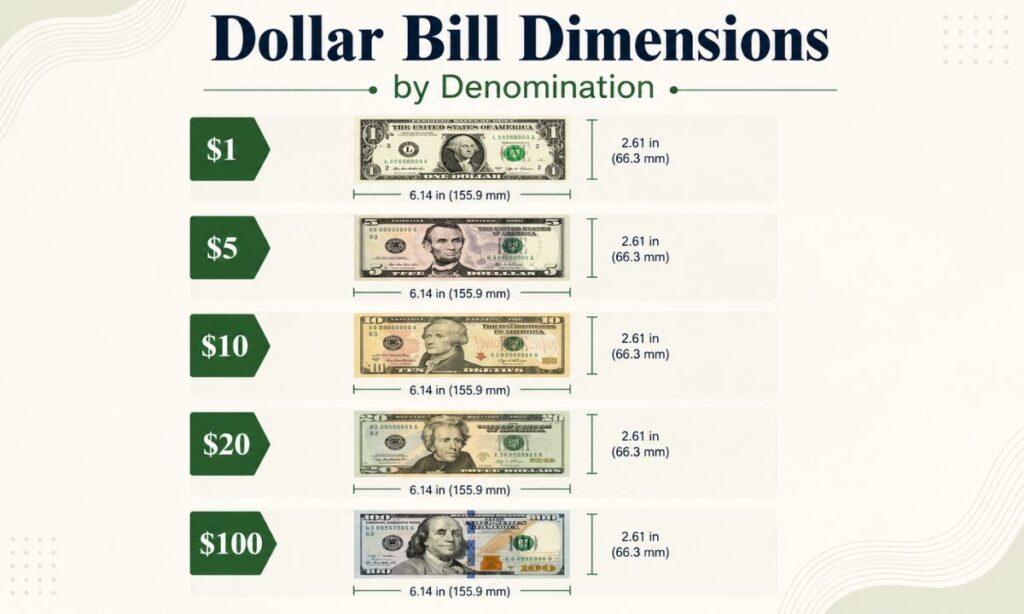
Every denomination shares the same currency size, but the design, colors, and security features are completely different. Knowing what is on each bill makes you a sharper spotter of counterfeits. Here is a full breakdown.
Common Denominations
$1 Bill Dimensions Measures 6.14 x 2.61 inches, featuring George Washington on the front based on Gilbert Stuart’s Athenaeum Portrait. The back shows the Great Seal of the United States, the eagle on the right and the unfinished pyramid with the all-seeing eye on the left. This is the most printed denomination in American history.
$5 Bill Size Same standard bill dimensions, with Abraham Lincoln on the front and the Lincoln Memorial on the back. Purple security features and updated watermarks were added in recent series to fight counterfeiting. Look closely and you will spot a tiny “USA” printed inside the security thread.
$10 Bill Measurements Identical paper currency dimensions, with Alexander Hamilton on the front. Hamilton was never a U.S. president, making him and Benjamin Franklin the only non-presidents featured on current circulating U.S. paper money. The U.S. Treasury building sits on the reverse side.
$20 Bill Dimensions Andrew Jackson replaced Grover Cleveland on the front decades ago. The White House fills the back design. The $20 bill size remains 6.14 x 2.61 inches and it is the most circulated denomination in the entire country, found in nearly every ATM in America.
$50 Bill Size Ulysses S. Grant on the front, the U.S. Capitol on the back. Green and peach color blending helps security teams identify fakes fast. Maintains the exact same official dollar bill size as every other denomination.
$100 Bill Dimensions Benjamin Franklin on the front, Independence Hall on the back. This bill has the most advanced security features including a 3D security ribbon, color-shifting ink, and a portrait watermark. Despite being the highest value in everyday circulation, the $100 bill dimensions are still exactly 6.14 x 2.61 inches.
Rare and Discontinued Bills
The $2 bill still exists and is legal tender today. Thomas Jefferson is on the front, the signing of the Declaration of Independence on the back. Many people hoard them thinking they are rare but they are just uncommon in daily circulation, not actually scarce.
Large bills like the $500, $1,000, $5,000, and $10,000 were all discontinued in 1969. The Federal Reserve pulled them to reduce the ease of moving large sums for organized crime. All shared the same standard U.S. bill dimensions of 6.14 x 2.61 inches introduced in 1929.
The $10,000 bill featured Salmon P. Chase, Treasury Secretary under Lincoln and later Chief Justice. Only a few hundred survive today, most locked in museums or private collections. If you ever find one, it is worth far more than ten thousand dollars.
Dollar Bill Thickness and Stack Height
The thickness of a dollar bill is so small most people never think about it.
But when you start stacking bills, the math gets genuinely wild.
Here is everything broken down simply.
How Thick Is a Dollar Bill?
A single dollar bill thickness is 0.0043 inches, or 0.109 mm. That is thinner than two sheets of standard copy paper. Yet it feels more solid because of what it is actually made from.
U.S. bills are not paper in the traditional sense. They are woven from 75% cotton and 25% linen, which gives them incredible durability. A dollar bill can survive around 4,000 folds before it tears.
This composition also makes them resistant to moisture and daily wear. The currency thickness stays consistent across all denominations. That uniformity is critical for machines that count and verify bills automatically.
Stack Calculations
Here is where it gets fun. Stack 10 bills and you get roughly 0.43 mm, barely visible. Stack 100 bills and you are looking at about 0.43 inches, less than half an inch tall.
1,000 bills in ones stacks to about 4.3 inches, roughly the height of a coffee mug. 10,000 bills reaches around 43 inches, or just over three and a half feet tall. One million dollars in $1 bills stacks to approximately 358 feet, taller than the Statue of Liberty at 305 feet.
Now flip that math. One million dollars in $100 bills shrinks the stack to just 3.58 feet, small enough to fit in a large carry-on bag. That is why high-value transactions always use large denominations. Less bulk, same value.
What Is a Dollar Bill Actually Made Of?

Most people assume bills are just fancy paper. They are not even close to regular paper. U.S. currency composition is a very specific blend of 75% cotton and 25% linen sourced under strict government contract.
This blend gives bills their distinct feel.
You have felt it before, that slightly rough, fabric-like texture that regular paper does not have.
That texture is intentional and one of the hardest things for counterfeiters to fake.
The ink used on dollar bills is also proprietary. Magnetic ink is used in specific areas so counting machines can verify authenticity instantly. Color-shifting ink on higher denominations shifts from gold to green depending on the angle you hold the bill.
Upcoming Changes to U.S. Currency Design
The dollar bill size is not changing. But the designs are. The U.S. Treasury announced that Harriet Tubman will replace Andrew Jackson on the $20 bill, a redesign that has been delayed multiple times but remains officially confirmed.
This will be the first time a woman appears on circulating U.S. paper currency in over a century. The physical $20 bill dimensions will stay exactly the same at 6.14 x 2.61 inches. Only the portrait and some design elements will be updated.
Higher denominations are also due for security upgrades. The newer $100 series already introduced the 3D security ribbon, and future updates are expected to add more advanced features. None of these changes affect the standard American dollar bill measurements or physical size.
Conclusion
The U.S. dollar bill has stayed at 6.14 x 2.61 inches since 1929. Nearly a hundred years of wars, crises, and change, and the size never moved. That consistency is a quiet kind of power.
Now you know the exact dollar bill dimensions, how they compare across denominations, what the bills are made from, how stacks add up, and what changes are coming. If this helped you out, drop a comment below or share it with someone who would find it useful. And if you are curious about other everyday object dimensions, check out our pieces on beverage can sizes and Pokémon card dimensions.