
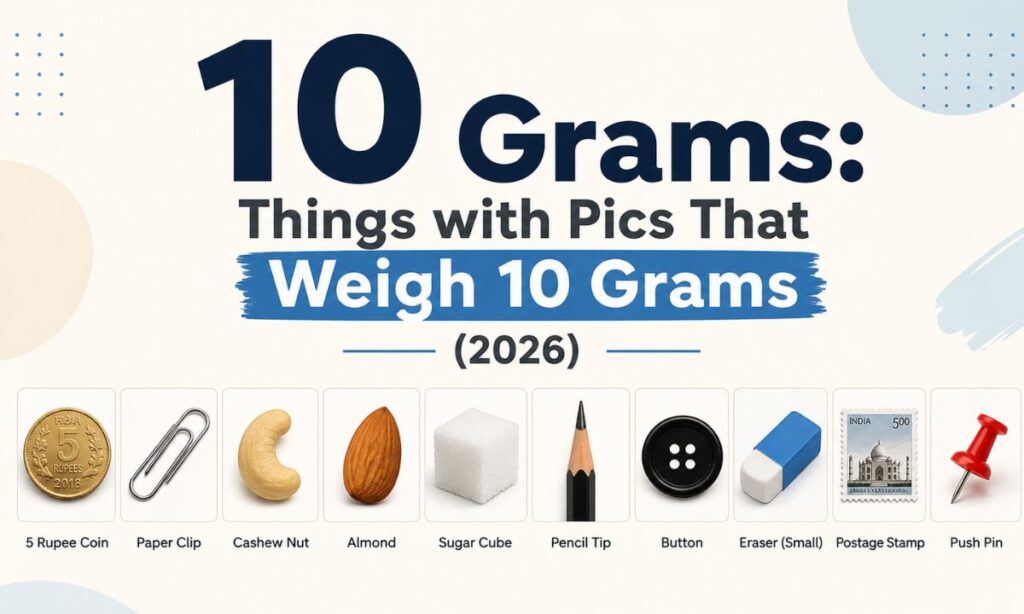

Ever been in the middle of cooking and realized your kitchen scale is dead? Or maybe you need to ship something small and have zero idea if it hits 10 grams. You are not alone. This happens more than you think, and the fix is simpler than you expect.
10 grams is a small but super useful weight to understand. It shows up in cooking, postage, medicine, jewelry, and everyday life. Once you know what common objects hit that mark, you will never be stuck again.
What Is 10 Grams?
Ten grams is a metric unit of mass equal to one hundredth of a kilogram. It sits just above the weight of a standard US nickel pair and just below a small handful of almonds. If you have never thought about it before, you are about to realize how often this weight pops up around you.
Think of it this way: 10 grams is roughly the weight of two coins, a few sheets of paper, or a small snack portion. It is light enough to hold between two fingers and barely notice. But in baking, chemistry, or postage, getting it right matters a lot.
The cool thing is that once you memorize two or three reference objects, you become your own human scale. No batteries needed. No app required. Just the right knowledge and a couple of nickels in your pocket.
How Much is 10 Grams in Other Units?
Here is a quick conversion table so you always have the numbers handy:
| Unit | 10g Equals | Notes |
| Kilograms | 0.01 kg | 1000g in a kilo |
| Milligrams | 10,000 mg | 1g = 1,000 mg |
| Pounds | 0.022 lb | 1 lb = 453.6g |
| Ounces | 0.35 oz | 1 oz = 28.35g |
| Carats | 50 ct | Used in gemstones |
| Grains | 154.3 gr | Used in pharmacy |
| Teaspoons | ~2 tsp | For granulated sugar |
| Tablespoon | ~0.67 tbsp | Varies by density |
A lot of people ask if 10 grams equals half an ounce. It does not. Half an ounce is about 14 grams. Ten grams is closer to one third of an ounce. Now that the numbers are clear, let us get into the fun part.
Everyday Things That Weigh 10 Grams
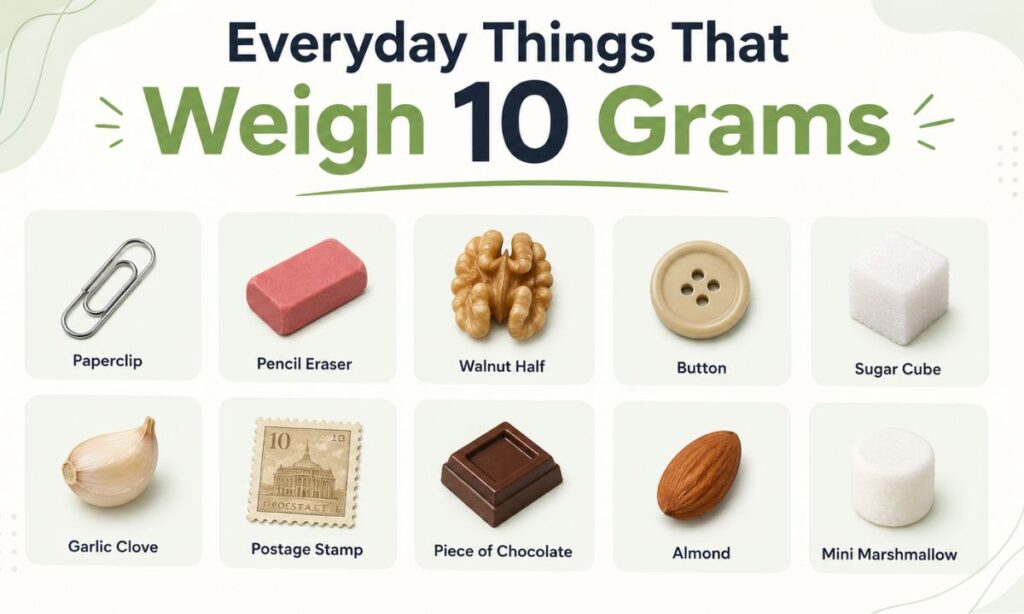
You already own most of these items. You just never thought about their weight before. Here is a quick reference, then the full breakdown below:
| Item | Weight | Details |
| 10 Paper Clips | ~10g | 1g each – office staple |
| 2 US Nickels | Exactly 10g | 5g each – 75% copper |
| 4 US Pennies | Exactly 10g | 2.5g each – post-1982 |
| 2 A4 Sheets | ~10g | 80 gsm – 5g per sheet |
| 10 US Dollar Bills | Exactly 10g | 1g each – cotton-linen |
| 2 Credit Cards | ~10g | 5g each – PVC standard |
| 1 Graphite Pencil | ~6-7g | Unsharpened No. 2 – approx |
| 2 tsp Sugar | ~10g | Granulated – leveled |
| 1 tbsp Flour | ~8-9g | Spoon and level method |
| 7-10 Almonds | ~10g | 1-1.5g each – raw |
| 4 Ping-Pong Balls | ~10.8g | 2.7g each – 40mm standard |
| 10 Thumbtacks | ~10g | 1g each – metal standard |
Ten Standard Paper Clips
Pick up ten regular office paper clips and you have almost exactly 10 grams in your hand. Each standard metal paper clip weighs approximately 1 gram, making ten of them a reliable everyday weight reference. They are uniform, cheap, and found in almost every drawer, bag, or desk in the world.
This works because paper clips are manufactured to tight tolerances. The steel wire gauge stays consistent across brands like Gem and Acco. So whether you grab ten from your work desk or your kid’s art supplies, the weight stays consistent.
Pro tip: keep a small ziplock bag with ten clips in your kitchen or home office. Instant 10 gram reference whenever you need it. No scale, no stress.
Two US Nickels
This is the easiest and most accurate one on the list. Each US nickel weighs exactly 5 grams, so two of them give you a perfect 10 grams every single time. The US Mint has kept this weight consistent since 1866.
Nickels are made from 75% copper and 25% nickel alloy. That blend creates a very stable, predictable weight that does not change with age or wear. This is why jewelers and small scale calibrators still use coins as reference weights.
If you only remember one thing from this article, remember this: two nickels = 10 grams exactly. Check your change jar, check your car cupholder, check your coat pocket. You almost definitely have them already.
Four US Pennies
Four modern US pennies weigh exactly 10 grams. Each penny minted after 1982 weighs 2.5 grams, which means four of them land perfectly on that 10 gram mark. Simple math, reliable result.
Before 1982, pennies were mostly copper and weighed slightly more. After 1982, the US Mint switched to a zinc core with a thin copper coating. The weight came down to 2.5 grams and has stayed there ever since.
So if you are rummaging through your wallet right now, grab four pennies. That small stack in your palm is your new portable gram measurement reference. Works every time.
Two Sheets of A4 Paper
Two sheets of standard 80 gsm A4 office paper weigh approximately 10 grams together. Each sheet comes in at around 5 grams, making the pair a handy and surprisingly accurate reference. GSM stands for grams per square meter, so the math behind this one is literally baked into the paper.
Most office paper falls between 70 and 100 gsm, with 80 gsm being the global standard for everyday printing. If your paper pack says 80g or 80 gsm on the label, each sheet is right around 5 grams. Two sheets equals 10 grams.
This one is great for anyone who works at a desk. You are surrounded by your scale reference without even realizing it. Grab two sheets from the printer tray and you are sorted.
Also Read:Dollar Bill Dimensions: Size, Height, (2026)
Ten US Dollar Bills
Here is a fact that surprises most people: every US dollar bill weighs exactly 1 gram, regardless of denomination. A one dollar bill and a hundred dollar bill weigh the same. Stack ten of any bills and you have a perfect 10 gram reference.
US currency is not made from regular paper. It is a blend of 75% cotton and 25% linen, which makes it more durable and gives it that distinct feel. This unusual material also keeps the weight perfectly consistent across every bill ever printed.
So next time you pull out your wallet, know that ten bills of any kind equal 10 grams. Use a mix of ones and fives if you like. The weight does not change.
Two Credit or Debit Cards
Two standard PVC credit cards or debit cards weigh approximately 10 grams combined. Each card sits at around 5 grams thanks to international ISO standards for card dimensions and materials. Gift cards, loyalty cards, and transit cards follow the same standard.
The ISO 7810 ID-1 format dictates that every standard payment card measures 85.6mm x 54mm x 0.76mm. That consistent size and thickness keeps the weight locked at roughly 5 grams per card. Metal premium cards like the American Express Platinum are exceptions and weigh significantly more.
For everyday plastic cards, two of them give you a solid 10 gram estimate. Just make sure you are not using a thick metal card for this one.
One Standard Graphite Pencil
A fresh, unsharpened No. 2 pencil weighs between 6 and 7 grams depending on the brand and wood type. Some longer or heavier models reach closer to 10 grams, but most standard pencils sit slightly below. Use it as a close approximation rather than an exact reference.
Pencils are made from a core of graphite mixed with clay, surrounded by cedar or basswood casing. The H and B hardness grades slightly change the graphite to clay ratio, which affects the weight by a small fraction. An unsharpened pencil is your best bet since sharpening removes material.
If precision matters, stick to the coins. But if you just need a rough ballpark for a lightweight object comparison, a fresh pencil works fine. It is close enough for most practical purposes.
Two Teaspoons of Granulated Sugar
Scoop two level teaspoons of white granulated sugar and you have approximately 10 grams. Each level teaspoon of granulated sugar weighs about 4 to 5 grams when properly leveled off. This is one of the most used references in baking and nutrition tracking.
The key word here is level. A heaping teaspoon can add an extra gram or two. Use the back of a knife to scrape it flat for the most accurate result. This technique is called the spoon and level method and it is standard in recipe development.
Brown sugar and powdered sugar behave differently because of how they pack. Powdered sugar is lighter and airier, while brown sugar packs tightly. For a clean 10 gram reference, stick to plain white granulated.
One Tablespoon of Flour
One properly measured tablespoon of all-purpose flour weighs around 8 to 9 grams. It is not a perfect 10 grams, but it is close enough to use as a rough guide in a pinch. The exact weight depends entirely on how you measure it.
Scooping flour directly from the bag packs it down and can push the weight up to 10 or 11 grams per tablespoon. The correct method is to spoon flour into the measuring spoon and then level it off. That technique keeps it in the 8 to 9 gram range.
For baking, always use a digital kitchen scale when the recipe calls for grams. The tablespoon method is useful for quick eyeballing, not for precision. But as a weight visualization tool, it still earns its place on this list.
Seven to Ten Almonds
A small handful of raw almonds lands right around 10 grams. Each individual almond weighs between 1 and 1.5 grams depending on variety and size. Seven smaller almonds or ten petite ones will give you your 10 gram mark.
Almonds are one of the best portion control references for healthy eating. A 10 gram serving gives you healthy fats, protein, and fiber without going overboard on calories. Nutritionists often suggest using this as a palm portion guide.
Next time you are snacking, count seven to ten almonds before tossing them in your mouth. That is your 10 gram serving. Tasty and educational at the same time.
Four Standard Ping-Pong Balls
Four regulation table tennis balls weigh approximately 10.8 grams together. Each ball weighs 2.7 grams according to the International Table Tennis Federation standards. Yes, that is slightly over 10 grams, but it is close enough to visualize the weight well.
Table tennis balls must measure exactly 40 millimeters in diameter under ITTF rules. They are made from celluloid or non-flammable plastic, both of which keep the weight extremely consistent. That predictable weight makes them useful as a casual reference.
If you have a bag of ping-pong balls at home, grab four of them. Hold them in your palm and you have a solid mental image of what just over 10 grams feels like. Close enough to be useful, not so far off that it misleads you.
Ten Thumbtacks
Ten standard metal thumbtacks weigh around 10 grams total. Each tack comes in at approximately 1 gram, just like paper clips. They are consistent, uniform, and easy to count.
Thumbtacks are made from steel or aluminum with a plastic or metal head. The manufacturing process keeps the weight tight across virtually all standard office thumbtack brands. One gram per tack, ten tacks, ten grams.
This one is perfect for anyone who works with bulletin boards or craft projects. You likely already have a box sitting on your desk or in your supply drawer. Ten of them in your palm is your 10 gram reference right now.
How to Measure 10 Grams Without a Scale
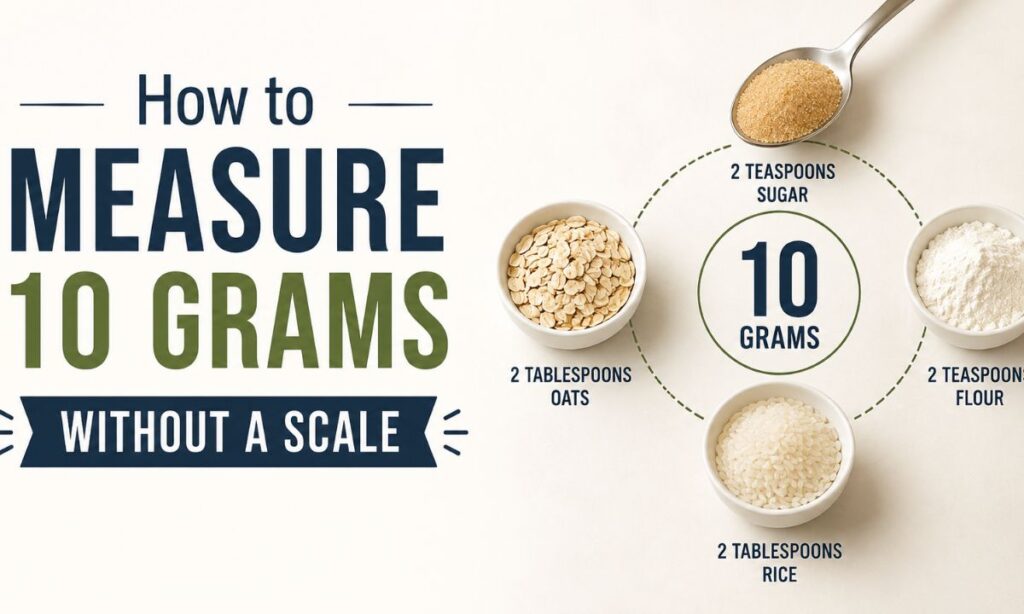
No scale at home? No problem. There are three practical ways to get close to 10 grams using things you already own. Each method has a different accuracy level, so pick the one that matches your need.
Using Kitchen Measuring Spoons
Measuring spoons are everywhere in kitchens and they work surprisingly well for estimating gram weights of common ingredients. The key is knowing that volume and weight are not the same thing. Different ingredients have different densities, so the conversion changes depending on what you are measuring.
Here is what works for common items:
• Granulated sugar: two level teaspoons equal about 10 grams
• Table salt: about one and a half teaspoons gets you close
• Water: two teaspoons is almost exactly 10 grams
Always level off the top with a straight edge. A heaping spoon throws off the estimate. Simple habit, much better result.
Using Common Household Items
This is the most creative method and honestly the most fun. Two US nickels, four pennies, ten paper clips, or ten dollar bills all equal exactly 10 grams. You can even build a simple balance scale using a ruler balanced on a pencil as a fulcrum.
Place your reference object on one side of the ruler. Place whatever you are measuring on the other. When the ruler balances level, the weights match and you have your 10 gram reference confirmed.
This old school balance trick works better than most people expect. It is not perfect, but for non-critical situations it gets you very close. Great for science projects too.
Using a Digital Kitchen Scale (Most Accurate)
If accuracy matters, nothing beats a digital kitchen scale. Modern scales are affordable, often under fifteen dollars, and they measure to within 0.1 grams. That level of precision matters in baking, medicine, and any task where being off by a gram causes real problems.
The correct technique: place the scale on a flat surface, turn it on, and place your empty container on it. Press the tare button to zero out the container weight. Then add your ingredient slowly until the display reads exactly 10 grams.
For cooking, nutrition tracking, and postage, a digital scale is the long term solution. The household object tricks are great for emergencies. But a ten dollar kitchen scale pays for itself very quickly.
Why Knowing 10 Grams Matters in Real Life
This is not just trivia. Knowing what 10 grams looks like saves you time, money, and frustration in ways most people never think about. Here are real scenarios where it actually matters.
• Baking: being off by 10 grams of flour or sugar can change the texture of cookies or bread entirely
• Shipping: packages under certain weight thresholds qualify for cheaper postage rates
• Nutrition: 10 grams shows up constantly in serving sizes for nuts, cheese, protein bars, and sugar limits
• Medicine: small dosage measurements in powders and supplements often reference this weight
10 Grams vs. Other Common Weights
Ten grams is easy to understand once you place it in context. Knowing how it compares to familiar weights builds your intuition for the metric system and everyday measurement.
How Does 10 Grams Compare?
Ten grams is one tenth of 100 grams and one hundredth of a kilogram. It is about one third of a standard ounce since one full ounce equals 28.35 grams. Compared to a pound at 453.6 grams, 10 grams represents just 2.2% of that weight.
Against a standard AA battery at about 23 grams, 10 grams is less than half. Against a single grape at about 5 grams, 10 grams is exactly two grapes. These comparisons help your brain build a mental map of gram weights without needing a calculator.
Once you internalize a few anchor points, estimating becomes second nature. Two nickels, two grapes, ten paper clips. That is your 10 gram toolkit right there.
FAQs About 10 Grams
How many teaspoons is 10 grams?
For granulated sugar, about two level teaspoons. For water, also about two teaspoons. For other ingredients, the answer changes based on density, so always check the specific item.
Is 10 grams equal to 1 tablespoon?
No. One tablespoon of water weighs 15 grams. One tablespoon of flour weighs about 8 grams. Volume and weight are not the same unit and cannot be swapped without knowing the ingredient density.
How do I measure 10 grams without a scale?
Use two US nickels for an exact measurement. Or use four US pennies, ten paper clips, or two level teaspoons of sugar. These are your most reliable no-scale options.
Is 10 grams half an ounce?
No. Half an ounce equals roughly 14 grams. Ten grams is about 0.35 ounces, which is closer to one third of an ounce.
Can I use a phone app as a gram scale?
Phone scale apps vary heavily by device. They can give a rough idea for small objects, but a cheap digital kitchen scale is far more accurate and worth the small investment.
Conclusion
Now you know exactly what 10 grams looks and feels like. Two nickels in your pocket, ten clips on your desk, two sheets of printer paper in your hand. You have been carrying a gram scale this whole time without knowing it.
Whether you are cooking, shipping, tracking nutrition, or just satisfying a curiosity, these everyday references give you a reliable mental toolkit. No app download required, no batteries needed, no excuses.
Drop a comment below and let us know which 10 gram object surprised you the most. And if this helped, share it with someone who is always stuck in the kitchen without a scale.