
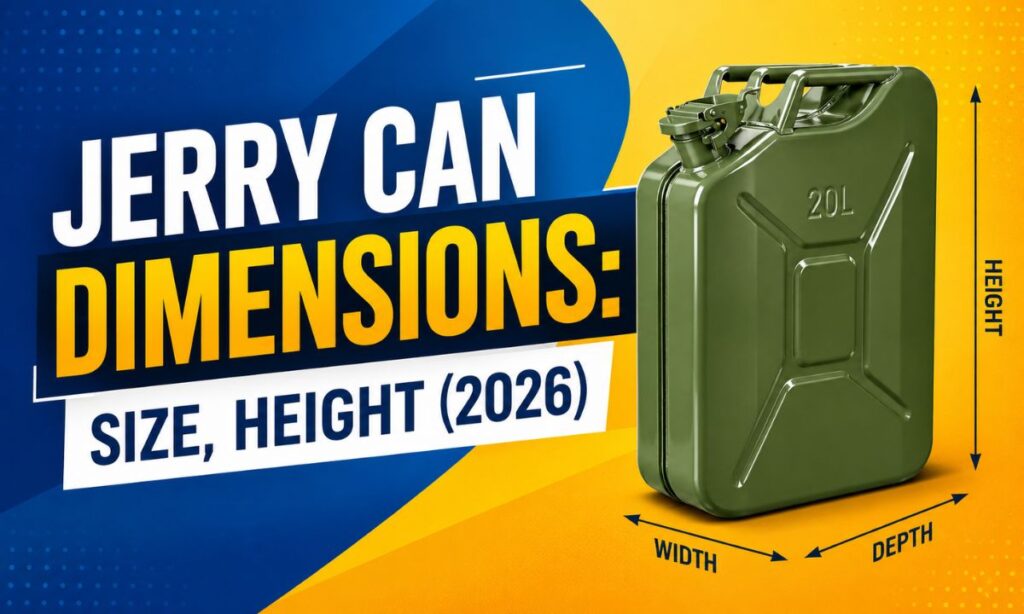

Looking for the exact jerry can dimensions before you buy one?
Here’s the short answer: a standard 20 liter jerry can is about 17 to 18 inches tall, 13 to 14 inches long, and 6 to 7 inches wide.
Smaller cans shrink down from there, and bigger ones grow taller and wider.
This guide breaks down every size so you know exactly what will fit in your garage, truck, or storage shed.
Most people search for this because they’re stuck.
Maybe you’re buying a fuel can and don’t know if it fits in your trunk.
Maybe you run a farm and need to know how many 20L jerry cans fit on one shelf.
Either way, we’ve got real numbers below, not guesses.
Jerry Can Dimensions Comparison Chart
Want the quick version?
This chart lays out jerry can size by capacity so you can scan it in ten seconds.
All numbers are in inches for size and pounds for empty weight.
S — Small Capacity (1-5 Liters)
| Capacity | Height | Length / Width | Empty Weight |
| 1L | 7-8″ | 5-6″ / 3-4″ | 0.5 lbs |
| 2L | 8-9″ | 6-7″ / 4-5″ | 0.8 lbs |
| 5L | 10-12″ | 8-9″ / 4-5″ | 1.5 lbs |
M — Medium Capacity (10-15 Liters)
| Capacity | Height | Length / Width | Empty Weight |
| 10L | 14-16″ | 10-11″ / 5-6″ | 2.5 lbs |
| 15L | 16-17″ | 11-12″ / 6-7″ | 3 lbs |
L — Large Capacity (20-25 Liters)
| Capacity | Height | Length / Width | Empty Weight |
| 20L | 17-18″ | 13-14″ / 6-7″ | 4 lbs |
| 25L | 18-20″ | 14-16″ / 7-8″ | 5 lbs |
XL — Extra-Large Capacity (30+ Liters)
| Capacity | Height | Length / Width | Empty Weight |
| 30L | 19-21″ | 15-17″ / 8-9″ | 6 lbs |
These are average ranges across plastic jerry can and metal models.
Your exact can might land a half inch off in either direction.
Always check the manufacturer page before you order in bulk.
ALSO READ6 Inches: 8 Things with Pictures That Are 6 Inches Long
How Jerry Can Dimensions Are Measured
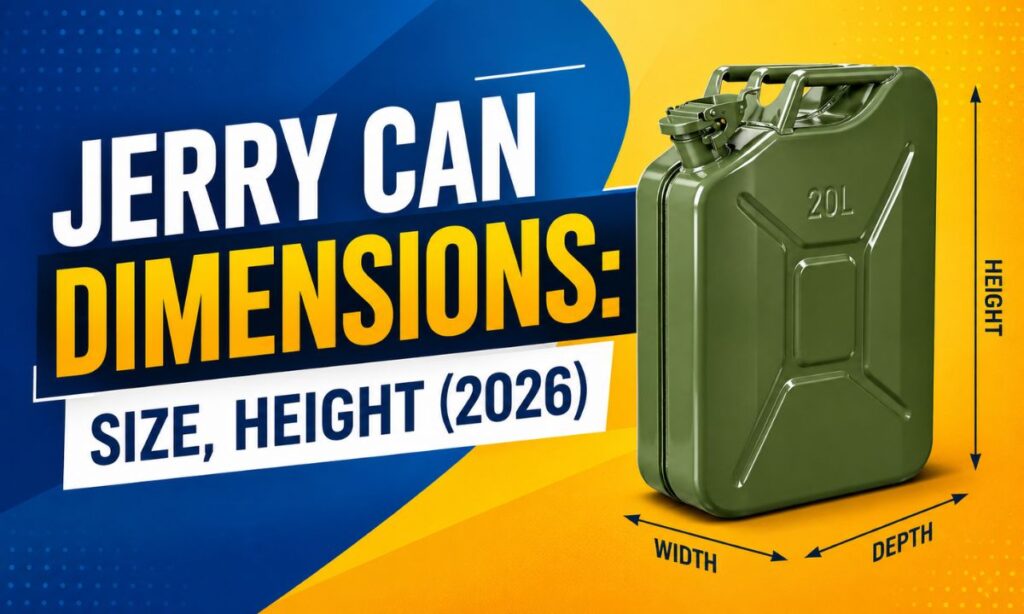
So how do brands actually measure these things?
Height is measured straight up from the base to the very top of the cap, not the handle.
Length and width get measured at the widest point of the can’s body, usually right at the shoulders.
Here’s something that trips people up.
A 25 liter can might only be 2 inches taller than a 20 liter can, even though it holds 5 liters more.
That’s because wall shape and design change how much liquid storage fits inside without changing the outside size much.
Handles and spouts also eat into your space planning.
A can listed at 18 inches tall might need 20 inches of shelf clearance once you add the spout and cap.
Always add a couple of inches of buffer when you’re measuring your storage spot.
Standard Jerry Can Dimensions by Capacity
Let’s go size by size and talk about what each one is actually good for.
This section pairs the numbers with real use cases, so you’re not just staring at a chart.
Small Capacity Jerry Cans (1-5 Liters)
A 5 liter jerry can measures 10 to 12 inches tall, 8 to 9 inches long, and 4 to 5 inches wide.
It weighs about 1 to 1.5 pounds empty, light enough to toss in a backpack.
This size is the go to for campers, boaters, and anyone topping off a lawn mower.
The 1 to 2 liter sizes are even smaller, around 7 to 9 inches tall.
These tiny cans are perfect for hand sanitizer refills, vet medicine, or kitchen oil.
Think of them as the travel size version of the jerry can family.
For a quick size check, a regular soda can stands about 4.8 inches tall.
A 5L jerry can is roughly twice that height, so picture two soda cans stacked up.
That mental picture makes it way easier to judge if one fits your space.
Medium Capacity Jerry Cans (10-15 Liters)
A 10 liter jerry can stands 14 to 16 inches tall and weighs around 2 to 2.5 pounds empty.
This is the size farmers and field workers reach for because it’s still light enough to carry one handed.
It also fits neatly into most equipment racks and truck bed organizers.
Bump up to 15 liters and the height only grows to 16 or 17 inches.
That small jump in size for 5 extra liters makes the 15L can a smart upgrade if you’re tight on shelf space.
Cleaning crews and maintenance teams often pick this size for chemical storage.
Large Capacity Jerry Cans (20-25 Liters)
The 20 liter jerry can is the most common size on the planet, sitting at 17 to 18 inches tall.
Length runs 13 to 14 inches and width sits around 6 to 7 inches.
Empty it weighs 3 to 4 pounds, but filled with fuel it can reach 44 to 48 pounds.
This is the size the military made famous, and it’s still the benchmark for fuel storage worldwide.
A 25 liter version stretches to 18 to 20 inches tall and 14 to 16 inches long.
Filled weight on the 25L can pass 55 pounds, so plan on a firm grip and good footing.
These large sizes work best when they’re staying put.
If you’re hauling fuel across a job site daily, the 20L size saves your back.
If it’s mostly sitting in storage, the 25L gives you more bang for your shelf space.
Extra-Large Jerry Cans (30+ Liters)
A 30 liter jerry can reaches 19 to 21 inches tall and 15 to 17 inches long.
Filled weight blows past 70 pounds, which usually means two people or a hand truck.
These show up most at bulk distribution points and big job sites, not your average garage.
If you’re considering this size for home use, ask yourself one honest question.
Will you ever actually lift this full?
Most households are better off with two 20L cans instead of one 30L can.
Jerry Can Dimensions by Material Type

Size isn’t the only thing that changes the numbers.
What the can is made from shifts the weight a lot, even when the outer size barely moves.
HDPE (High-Density Polyethylene) Jerry Can Dimensions
HDPE jerry can containers keep the same outer size as metal ones but weigh roughly 40 to 50 percent less empty.
Wall thickness usually runs 2 to 4mm, which barely changes the outside measurements.
This makes HDPE the top pick for anyone storing chemicals, since the plastic resists acids and solvents well.
Food grade HDPE cans use the same dimensions as the industrial versions.
There’s no size penalty for going food safe, which is good news if you’re storing drinking water or cooking oil.
UV resistant coatings get added without changing the can’s footprint either.
Metal Jerry Can Dimensions
Steel jerry cans follow military style sizing almost exactly, with the classic NATO jerry can measuring close to 17.75 inches tall.
Length sits near 13.5 inches and width near 6.5 inches, the same shape that’s been used since World War 2.
Steel adds weight though, usually 6 to 8 pounds empty compared to the lighter plastic versions.
Aluminum splits the difference nicely.
It keeps the same outer size as steel but drops the empty weight down to 4 to 5 pounds.
Racing teams and aviation crews like aluminum because it’s strong without the extra heft.
Different Types of Jerry Cans and Their Dimensions
Not every jerry can on the shelf is built the same, even at the same liter size.
Safety rules and intended use change the shape more than you’d expect.
Type 1 vs Type 2 Gas Can Dimensions
Type 1 gas cans have a simple spout and basic cap, keeping the overall size compact.
A 5 gallon Type 1 can usually stands around 17 inches tall with nothing extra sticking out.
These were the standard before 2009 safety rules changed things.
Type 2 gas cans add 2 to 3 extra inches to the height because of child resistant caps and auto shutoff spouts.
CARB compliant cans sold in California go even further with vapor recovery systems built into the cap.
If you’re shipping a can across state lines, double check which type you actually have.
Specialty Jerry Can Dimensions
Racing fuel cans often add quick fill spouts that stick up 3 to 5 inches past the standard cap height.
Water storage jerry cans use the exact same body size as fuel cans but swap in food grade plastic.
That means you can plan storage space the same way, you just can’t mix up which can holds what.
Square stackable jerry cans are the new kid on the block.
They trade the classic curved shape for flat sides, which uses warehouse shelf space far better.
If you’re storing a lot of cans long term, square designs save real floor space over time.
Jerry Can Storage and Space Planning
Buying the can is only half the job.
Here’s how to actually plan the space for it without guessing.
Calculating Storage Space Based on Jerry Can Dimensions
Start with shelf clearance.
A 5 liter can needs about 12 inches of vertical room, while a 25 liter can needs 22 inches or more.
Add 2 to 3 extra inches on top of that so you can pull the can out without scraping the shelf above.
For floor space, multiply length by width to get the footprint.
A 20L can takes up roughly 0.6 square feet of floor space sitting on its base.
Multiply that by how many cans you’re storing to get your total footprint.
OSHA guidelines recommend stacking limits based on size too.
Stick to three cans high max for 20 to 25 liter sizes, since toppling risk goes up fast past that.
Smaller 5 to 10 liter cans can stack safely up to five high if they’re stabilized properly.
Vehicle Storage Considerations
Truck beds handle multiple 20L cans without much trouble, as long as you strap them down.
A standard sedan trunk usually fits two 10L cans or one 20L can, with a bit of room left over.
Measure your trunk depth first if you’re eyeing a larger can, because spouts and handles add length you might not expect.
Keep cans low in the vehicle, not stacked up high.
A lower center of gravity means less shifting if you brake hard or take a sharp turn.
Ratchet straps rated for the full filled weight are worth the few extra dollars.
Jerry Can Color Codes and What They Mean
This one trips up a lot of first time buyers.
Colors on jerry cans usually follow a safety code, not just a style choice.
• Red means gasoline
• Yellow means diesel
• Blue means kerosene or water
• Green is sometimes used for oils
These colors don’t change the jerry can dimensions at all, just the contents you should expect.
Always double check the label too, since color codes can vary slightly by manufacturer or country.
How to Choose the Right Jerry Can Size for Your Needs
Picking a size comes down to three honest questions.
How much liquid do you actually go through in a week or a job?
How much space do you have to store it, and how often will you lift it full?
If you’re a weekend camper, a 5L or 10L can covers you without taking up your whole trunk.
If you run equipment daily, a 20L can balances capacity and manageable weight well.
If you’re stocking a warehouse or job site, 25L or 30L cans make sense since lifting isn’t a daily one person task there.
FAQs About Jerry Can Dimensions
What are the standard dimensions of a jerry can?
The most common standard is the 20 liter NATO style can at 17.75 inches tall, 13.5 inches long, and 6.5 inches wide.
How tall is a 20L jerry can?
A 20L jerry can stands 17 to 18 inches tall from base to cap top, with metal versions landing right around 17.75 inches.
How big is a 5 litre jerry can?
A 5 litre jerry can measures about 10 to 12 inches tall, 8 to 9 inches long, and 4 to 5 inches wide.
How big is a 25L jerry can?
A 25L jerry can stands 18 to 20 inches tall, 14 to 16 inches long, and 7 to 8 inches wide.
How many liters is a standard jerry can?
20 liters is the worldwide standard, a size that traces back to World War 2 military design.
What is the difference between Type 1 and Type 2 gas cans?
Type 1 cans have a simple spout, while Type 2 cans add child resistant caps and auto shutoff valves, adding a couple inches to the height.
Are all fuel cans the same size?
No, sizes range from 1 liter portable cans up to 30 liter plus industrial containers, with 5L, 10L, 20L, and 25L being the most common.
Conclusion
Jerry can dimensions really come down to one simple idea, bigger capacity means a bit more height and width, but not always as much as you’d guess.
The 20 liter size remains the world’s go to standard because it balances how much it holds against how easy it is to carry.
Whether you’re stocking a garage, a farm, or a job site, matching the right size to your actual storage space and lifting ability will save you headaches down the road.
Measure your space first, pick your size second, and you’ll get this right the first time.