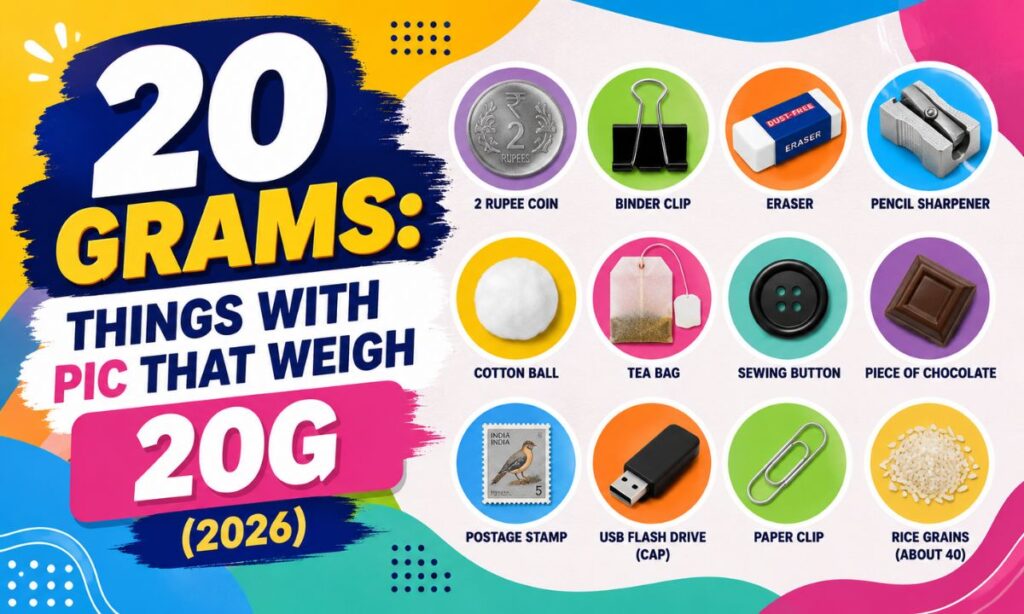

Ever picked something up and thought, “how much does this actually weigh?” Most people have no clue what 20 grams feels like until they hold it. Here’s the short answer: 20 grams is roughly the weight of four U.S. nickels, one AAA battery, or twenty regular paperclips.
Now let’s dig deeper so you never have to guess again.
What Does 20 Grams Mean?
Twenty grams is a small but very real weight that shows up in everyday life more than you think. In the U.S. measurement system, 20 grams equals 0.70 ounces, which is less than a single ounce but still clearly noticeable in your hand. It sits right in that sweet spot where it feels light but not invisible.
Think of it this way: a dollar bill weighs 1 gram, so 20 grams is like holding twenty dollar bills stacked together. The metric weight system makes this easy because grams scale up cleanly. Once you train your hand to recognize this weight, you will use it for portion control, cooking, shipping, and more.
Most people struggle to tell the difference between 15g and 25g without a scale. But once you connect 20g to a physical object you already own, your brain locks it in. That is the whole point of this guide.
9 Most Common Things That Weigh About 20 Grams
| Item | Approx. Weight | Quick Note |
| Four U.S. Nickels | 4 x 5g = 20g | Most reliable reference |
| One AAA Battery | 19 to 21g | Check Duracell or Energizer |
| Twenty Paperclips | 20 x 1g = 20g | Standard size only |
| One CD or DVD | 15 to 16g | Without case |
| 1 Tbsp Peanut Butter | 16g | Level spoon, creamy type |
| Twenty Jelly Beans | 20 x 1g = 20g | Standard size |
| BIC Lighter (Full) | 18 to 21g | Brand new hits closest to 20g |
| Twenty M&Ms | 20 x 1g = 20g | Milk chocolate only |
| Standard Highlighter | 18 to 22g | Sharpie brand near 20g when new |
Four U.S. Nickels
This is the most reliable 20 gram reference you will ever find. Each U.S. nickel weighs exactly 5 grams, confirmed by the U.S. Mint, so four of them always land at a perfect 20g. No guessing, no variation, just stack them and you are done.
The best part is you probably have four nickels in your pocket or change jar right now. This trick works anywhere in the country since nickel weight is federally standardized and never changes. Next time you are cooking or packing a package, grab four nickels and use them as your instant reference.
It takes about two seconds and costs nothing. Stack them flat in your palm and you will feel exactly what twenty grams feels like. Once you do this once, you will never forget the feeling.
A Standard AAA Battery
A standard AAA battery is one of the most common objects in any home and it weighs right around 20 grams. Brands like Duracell and Energizer produce their AAA batteries in the 19 to 21 gram range depending on the chemistry inside. Alkaline batteries land closest to 20g when brand new.
You likely have one in your TV remote, a flashlight, or a kid’s toy right now. Pull it out and hold it, that is your lightweight 20g item for the day. It fits perfectly in two fingers and gives you a clear sense of the weight.
One thing to note: lithium AAA batteries can weigh slightly less than alkaline ones. So if you want the most accurate feel, grab an alkaline version from a standard pack. Either way, a AAA battery weight is one of the best everyday references in this whole list.
Twenty Paperclips
Here is a fun one that works great for offices, classrooms, and kids learning about gram measurement. A standard number one paperclip weighs approximately 1 gram each, so counting out twenty gives you a clean 20 gram weight. The key word here is standard, because jumbo clips weigh more and will throw off your count.
Line them up, stack them, or hold them in your palm. Twenty standard paperclips feel almost like holding a small bundle of nothing, which is a great way to feel just how light 20 grams really is. This is also a great classroom trick for teachers explaining the metric system to young students.
Keep a count of twenty clips rubber banded together in your desk drawer. Now you have a free, reusable 20g reference object ready anytime. It is probably the cheapest measuring tool you will ever make.
A Compact Disc (CD)
A bare CD or DVD without its case weighs around 15 to 16 grams, making it slightly under our 20g target but still a solid reference point. The polycarbonate plastic disc is incredibly thin and light, which is why it sits in this range. If the disc has extra printing or thick coating layers, it may push closer to 16 to 17 grams.
For anyone who grew up in the 90s or 2000s, CDs are everywhere in old boxes and drawers. Grab one and hold it flat in your palm to get a sense of what lightweight objects in the 15 to 20 gram range feel like. It is not a perfect 20g match but it is close enough for a quick visual and physical comparison.
One correction worth noting: the original article claimed CDs can hit 20g, but in practice a standard bare disc comes in at 15 to 16 grams based on manufacturer data. So think of a CD as a slightly-under-20g reference rather than an exact match. Still a useful and relatable everyday weight example for most people.
A Tablespoon of Peanut Butter
Here is one that trips people up in the kitchen all the time. A level tablespoon of creamy peanut butter weighs about 16 grams, not 20 grams as some sources claim. If you heap the spoon slightly, you get closer to 18 grams, but a perfectly level spoon sits at 16g according to USDA nutritional data.
This matters a lot if you are tracking calories or protein intake. One level tablespoon gives you roughly 5 grams of protein and about 90 to 95 calories depending on the brand. Knowing the real weight helps you portion accurately without a scale.
For a true 20 gram portion of peanut butter, you need just a touch more than one tablespoon. Think of it as one tablespoon plus a small extra scoop. It is a small difference but worth knowing if you are serious about portion control.
Twenty Jelly Beans
This one is sweet and surprisingly accurate. A standard-sized jelly bean weighs close to 1 gram each, so twenty of them add up to right around 20 grams total. Jelly Belly beans and most generic store brands fall in this range, though size can vary slightly between brands.
This is a great visual for kids because candy is always memorable. Count out twenty beans, hold them in your cupped hand, and you have a real feel for twenty grams in candy form. It also makes for a fun way to explain weight concepts without a boring lecture.
One heads up: mini jelly beans weigh less and large gourmet versions weigh more. Stick with the classic standard-size jelly bean for the most accurate 1 gram per piece count. Either way, this is one of the most fun everyday 20g items on this entire list.
Also Read:White Claw Can Dimensions: Size, Height (2026)
A Disposable Lighter (BIC Lighter)
A brand new BIC lighter weighs between 18 and 21 grams when completely full of butane fuel. Fresh out of the package, it sits closest to the 20 to 21 gram range, making it a solid portable reference. As the fuel burns down, the lighter gradually loses a few grams.
Most households have at least one BIC lighter in a kitchen drawer or on a countertop. Pick up a new one and hold it, that is almost exactly what 20 grams feels like in a compact, familiar shape. The plastic body and metal components combine to create that consistent weight you can rely on.
If you want the closest possible reference to a true 20g object, a fresh BIC is one of your best bets on this list. Just make sure it is new and full, not a half-empty lighter that has been sitting around for months. A nearly empty BIC can drop down to 15 grams or less.
Twenty M&M’s Candies
Regular milk chocolate M&Ms weigh about 1 gram per piece, making twenty of them a nearly perfect 20 gram snack portion. The candy shell and chocolate center are produced to very consistent sizes, so this reference holds up well across different bags. This is one of the most enjoyable ways to understand what 20 grams feels like.
Count out twenty candies and hold them in your palm. You will notice how light they feel despite being twenty individual pieces. This is a great reminder of just how light 20 grams truly is in the grand scheme of things.
Important note: peanut M&Ms weigh 2 to 3 grams each, so they do not work for this reference. Stick with the original milk chocolate M&Ms for an accurate count. Peanut butter or almond varieties will also throw off the weight, so keep it classic.
A Standard Highlighter Pen
A standard highlighter pen weighs between 18 and 22 grams depending on the brand and how much ink is left inside. A brand new Sharpie highlighter sits right around 20 grams when full of ink. As the ink depletes from regular use, the weight drops gradually.
Students and office workers already have highlighters on their desks, so this is an incredibly easy reference to grab. Hold a new highlighter flat across your fingers and feel the weight. That is your 20g everyday object hiding in plain sight on your desk the whole time.
Check your desk drawer right now and grab the newest-looking highlighter you can find. If it feels full and heavy with ink, chances are it is sitting right around that 20 gram mark. It is one of the most accessible references for anyone working in a school or office setting.
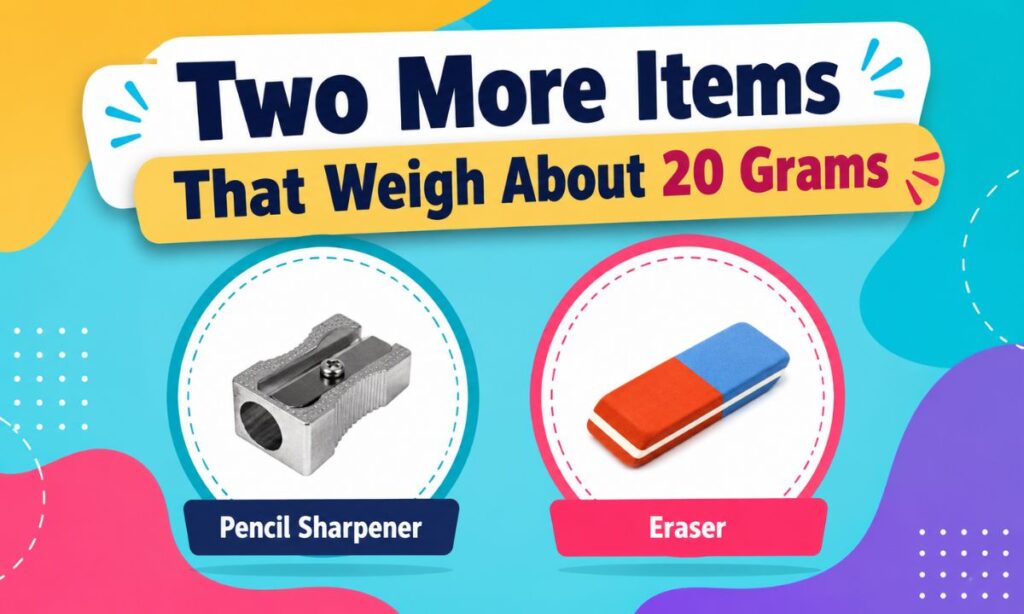
Two More Items That Weigh About 20 Grams
A Small USB Flash Drive
A standard USB flash drive weighs between 5 and 20 grams depending on its size and build material. Compact plastic drives with metal connectors often land right around the 18 to 20 gram range. If you have one lying around, it is a handy tech-world reference for this weight.
These are incredibly common in home offices, school bags, and desk drawers. The solid plastic casing and internal memory chip combine to create that consistent weight in smaller drive models. It is a surprisingly good small lightweight object for understanding what 20 grams feels like in a tech context.
A Standard Teabag
A single teabag with the paper tag and string weighs approximately 2 to 3 grams, but a full sachet-style or pyramid tea bag with dense tea leaves can weigh closer to 3 to 4 grams. For a true 20g reference, you would need roughly seven to eight standard teabags. However, a dense single-serve loose-leaf pouch from certain premium brands can hit the 15 to 20 gram range on its own.
This works best as a kitchen reference when you are portioning ingredients by feel. It connects weight to something warm and familiar, which helps the brain lock in the number. Tea lovers especially find this a natural and easy everyday weight comparison.
How to Measure 20 Grams Without a Scale
Using Common Household Items as References
You do not need a fancy kitchen scale to measure 20 grams at home. Four nickels, one fresh AAA battery, or twenty standard paperclips all give you a reliable physical reference. Keep a small collection of these in a kitchen drawer so you always have a quick comparison ready.
The trick is to build muscle memory by repeatedly picking up the same 20g reference item. Over time, your hand starts to recognize the weight instinctively. This is exactly what professional bakers and chefs do when they work without scales in fast-paced kitchens.
Start with the four nickels method since it is the most precise. Then branch out to other items to train your hand with different textures and shapes. Within a week you will be estimating small gram weights with surprising accuracy.
Kitchen Measurement Conversions
Water is the easiest liquid to convert because 20 milliliters of water equals exactly 20 grams at room temperature. This one-to-one ratio only works for water, though, so do not apply it to everything. Other kitchen ingredients have different densities and will give you different gram readings.
Here are some quick kitchen weight conversions worth knowing:
- Cooking oil: 20ml weighs about 18g due to lower density
- Granulated sugar: 1 tablespoon equals roughly 12 to 13 grams
- All-purpose flour: 1 tablespoon when sifted weighs only 8 to 10 grams
- Honey: 1 tablespoon weighs about 21 grams due to thickness
- Water: 1 tablespoon equals exactly 15 grams
These numbers matter for cooking without a scale and for tracking nutritional intake accurately. Once you memorize two or three of these, measuring in the kitchen becomes much faster.
DIY Balance Scale Method
You can build a simple DIY balance scale with a ruler and a pencil in about thirty seconds. Place the pencil flat on a table and balance the ruler across it like a seesaw. Put your unknown item on one end and add known 20g reference objects to the other side until both ends balance.
This method teaches kids about both weight and physics at the same time. It takes patience and a steady surface, but it genuinely works for rough measurements. Even adults find it surprisingly satisfying when the two sides finally balance out.
For best results, use a 30cm ruler and place the pencil exactly at the center mark. Use your four nickels as the known weight on one side. When both sides level out, your unknown item weighs approximately 20 grams.
Comparing 20 Grams to Other Weights
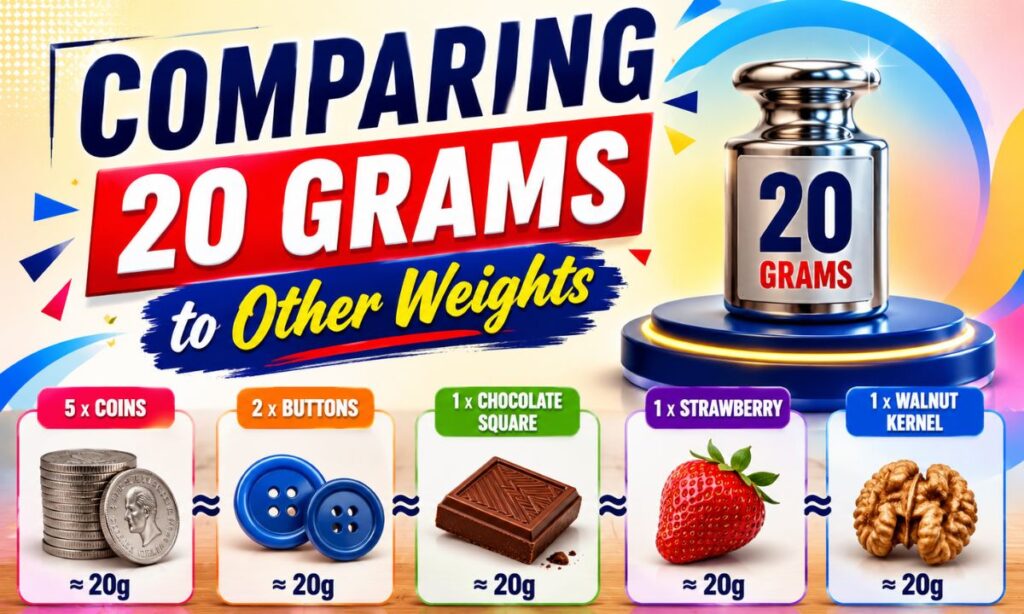
Lighter Than 20 Grams
A single U.S. nickel weighs exactly 5 grams, which is one quarter of our 20g target. A standard paper bill, regardless of denomination, weighs just 1 gram. Small stud earrings typically weigh between 2 and 5 grams per pair.
These lighter comparisons help you understand the scale below 20g. Once you know that a dollar bill is 1g and a nickel is 5g, building up to 20g feels very logical. Your brain starts to see gram measurements as a simple stacking game.
Heavier Than 20 Grams
A standard AA battery weighs about 23 grams, just slightly above our 20g mark. A golf ball tips the scale at around 45 grams according to USGA regulations. A large chicken egg with the shell averages between 50 and 60 grams.
These heavier references make 20 grams feel noticeably light by comparison. Once you hold a golf ball and then pick up four nickels, the difference is very clear. This contrast is one of the best ways to sharpen your weight estimation skills fast.
Visual Weight Progression
Building a mental scale of gram weights makes everyday estimation much easier. Here is a simple gram weight progression to memorize:
- 5g: One U.S. nickel
- 10g: Two nickels or ten paperclips
- 15g: Three nickels or a bare CD
- 20g: Four nickels or one AAA battery
- 25g: Five nickels or one AA battery
- 30g: Six nickels or a AAA battery plus two nickels
Practice picking up each of these weights regularly. Within a few days your hands will start to recognize the difference between 10g and 20g without even thinking about it. This is one of the most practical skills you can build for cooking, shipping, and everyday measurement.
Other Dimensions
Understanding small gram weights connects naturally to other measurement knowledge. If you found this guide useful, the same logic applies to understanding dimensions like paper sizes, product packaging, and shipping weights. Knowing your metric weight references makes you sharper in the kitchen, smarter at the post office, and more confident any time a scale is not around.
Conclusion
Twenty grams is lighter than most people expect until they actually hold it. Four U.S. nickels, a fresh AAA battery, or twenty standard paperclips all give you an instant and free 20g reference you can use anywhere. No scale needed, no guessing, just items you already own.
The real value here is not just knowing what weighs 20g. It is training your hands and your brain to recognize this weight naturally over time. Start with the nickels trick today, it takes two seconds and works every single time.
If you found one reference on this list that works for your life, bookmark this page and come back when you need a refresh. Drop a comment below and tell us which 20 gram item surprised you the most. Sharing this with someone who always loses their scale would genuinely help them out.