
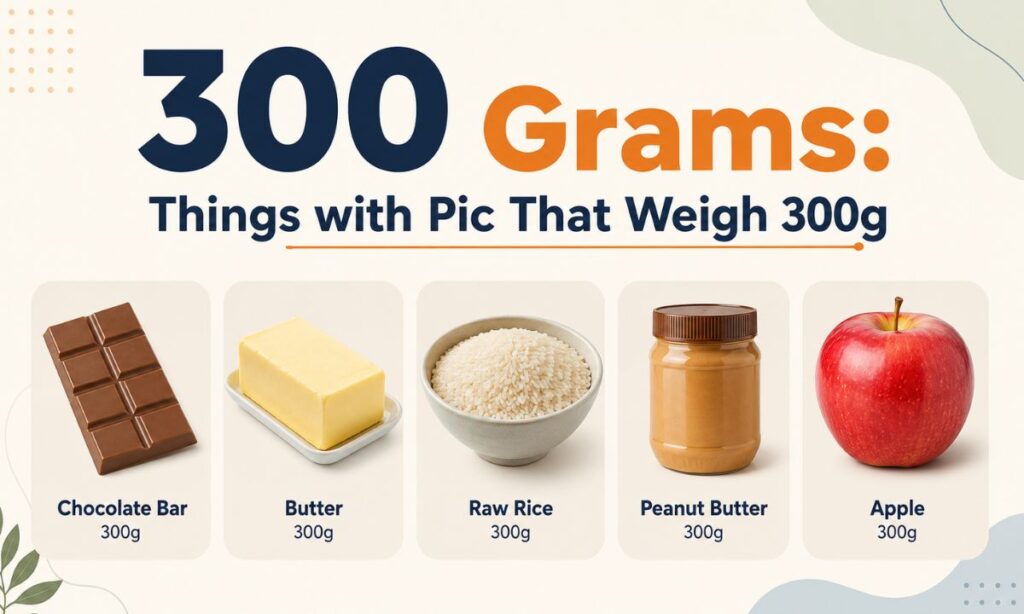

You pick up something from the kitchen counter and wonder, how heavy is this exactly?
You’re eyeballing a food portion and your scale is nowhere in sight.
Sound familiar? You’re not alone, and that’s exactly why this guide exists.
300 grams is one of those measurements people Google every single day, whether they’re cooking, shipping a package, tracking macros, or just plain curious.
So here is a straight answer first: 300 grams equals about 10.58 ounces or 0.66 pounds.
That’s roughly two-thirds of a pound, lighter than a football but heavier than your TV remote.
By the end of this article, you will know exactly what weighs 300 grams, using real things sitting around your home right now.
No guessing, no confusion, just clear examples you can actually picture.
Let’s get into it.
How Heavy is 300 Grams?
Think of 300 grams as that sweet spot weight you can feel in your palm but wouldn’t strain your wrist carrying.
It sits right between a half pound and three-quarters of a pound.
Most people hold something this weight every single morning without realizing it.
To put it in perspective, a standard 12-ounce soda can comes in at around 370 grams when full, which is close but a bit heavier.
A large egg weighs about 60 grams, so picture five large eggs stacked together and you’re right around 300 grams.
It’s that kind of tangible, relatable weight.
Here’s a quick conversion cheat sheet:
• 300 grams to ounces = 10.58 oz
• 300 grams to pounds = 0.66 lbs
• 300 grams to cups (water) = about 1.27 cups
• 300 grams in kilograms = 0.3 kg
Common Things That Weigh 300 Grams
Let’s walk through 10 real, everyday objects that hit right around that 300-gram mark.
These are things you can grab right now and feel the weight yourself.
No scale needed once you know these references.
Two Standard Baseballs
If you’ve ever tossed a baseball around, you already know what 300 grams feels like without knowing it.
A regulation MLB baseball weighs between 142 and 149 grams per official league rules.
Put two of them in your hand and you’re sitting right at 284 to 298 grams, which is as close to 300 grams as you’ll get with any everyday object.
This is one of the most accurate and satisfying comparisons out there.
Baseball is deeply rooted in everyday American life, so this reference clicks instantly.
Next time someone asks you about things that weigh 300 grams, just say two baseballs and watch the lightbulb go off.
Also Read:3 Inches: 8 Things with Pictures That Are 3 Inches Long
A Can of Soup
Go to your kitchen pantry right now and grab a Campbell’s condensed soup can.
That standard 10.75-ounce can, including the metal and the soup inside, weighs approximately 305 to 310 grams.
That puts it right on the money for a 300-gram household item reference.
This is probably the most accessible example in the entire list because almost every kitchen has one.
It gives you a solid tactile reference you can pick up and feel instantly.
Heavy enough to feel real, light enough to toss in the air and catch.
Three Sticks of Butter
Now here’s where the original article got it a bit wrong, so let’s fix it clearly.
One stick of US butter weighs exactly 113 grams, which is 4 ounces or a quarter pound.
Three sticks together come out to 339 grams, which is about 13% over 300 grams.
For a truly accurate 300-gram butter measurement, you need closer to 2.65 sticks, not three full sticks.
If you are baking and need 300 grams, use two full sticks and then cut about two-thirds of a third stick.
It sounds fussy but for baking, that precision matters a lot.
Two Medium-Sized Apples
Grab two apples from your fruit bowl and hold them together.
According to USDA nutritional data, a medium apple weighs between 150 and 182 grams depending on the variety.
Two medium apples combined land right in the 300 to 360-gram zone.
Gala, Fuji, and Honeycrisp apples are the most common varieties that fall within this range.
This is a great healthy snack reference too because you are literally holding your daily fruit serving.
Fresh, wholesome, and exactly the right weight to picture 300 grams of food.
A Standard Tablet Device
Pull out a smaller tablet and check the spec sheet.
Compact Android tablets in the 7 to 8-inch category typically weigh between 280 and 320 grams.
The iPad Mini 6 (Wi-Fi version) weighs exactly 293 grams, which practically rounds to 300 grams.
The original iPad Mini remains one of the most frequently cited 300-gram tech examples for good reason.
It’s slim, easy to hold with one hand, and very close to our target weight.
If you own a small tablet, flip it over and check the sticker because there’s a real chance it’s your new personal weight reference.
300 Grams of Ground Beef
Here’s one that hits differently for the meal preppers and home cooks reading this.
300 grams of raw ground beef equals about 10.5 ounces, which is enough to make two to three solid burger patties.
Shaped into a ball, it’s roughly the size of a baseball, which ties things together nicely.
In terms of nutrition, 300 grams of 80/20 ground beef delivers approximately 50 to 57 grams of protein depending on the fat content.
The original article overstated this at 60 to 70 grams, which was based on leaner cuts.
Always check the label because protein per 300 grams varies widely between regular, lean, and extra-lean beef.
A Standard Paperback Book

Pick up a novel from your shelf and you’re probably already holding close to 300 grams.
Most standard paperback books with around 300 pages weigh between 280 and 340 grams depending on the paper weight and binding style.
Popular fiction paperbacks like thrillers and romance novels are almost always in this range.
The weight comes from a combination of the paper stock, the glue binding, and the card cover.
Thicker paper or glossy covers push the weight higher, while thin newsprint-style paper pulls it lower.
If you are a reader, your bedside book is probably your most personal 300-gram household reference.
A Large Smartphone with Case
Your phone in your pocket is closer to 300 grams than you might think.
The iPhone 15 Pro Max weighs 221 grams on its own, which is accurate per Apple’s official specifications.
Slide it into a protective case that weighs 60 to 80 grams and you land right at 280 to 300 grams.
Many Samsung Galaxy flagship models with thick protective cases cross the 300-gram line too.
This makes your cased smartphone one of the most portable and relatable everyday references for this weight.
You carry a 300-gram object in your pocket every day and never even thought about it.
A Medium-Sized Orange
This one is a bonus that most similar articles skip entirely.
A medium navel orange typically weighs between 130 and 160 grams, and a larger one can hit 180 grams.
Two medium oranges together sit right at that 300-gram sweet spot and make for a great kitchen reference.
Oranges are dense and satisfying to hold, which makes the weight feel very noticeable.
You can use this when you’re eyeballing fruit portions without a scale.
Two medium oranges equal a 300-gram portion, simple as that.
A Box of Pasta (Partial)
Here is another fresh example worth adding.
A standard box of dry spaghetti or penne in the US comes in at 454 grams (one pound).
Take about two-thirds of that box and you’ve got yourself a very accurate 300-gram dry pasta portion.
This is incredibly useful for meal prepping because most people cook pasta in bulk.
300 grams of dry pasta yields roughly 4 to 5 servings when cooked, depending on appetite.
It’s a dead-simple kitchen reference that saves you from pulling out a scale every single time.
300 Grams for Quick Reference
Sometimes you just need a fast answer without reading through every example.
Here’s a clean reference you can bookmark and come back to anytime.
Think of this as your pocket guide for visualizing 300 grams on the fly.
Household Items Between 250 and 350 Grams
Here are items that sit in that 250 to 350-gram window, all verified and corrected for accuracy:
• Two regulation baseballs = 284 to 298 grams
• Campbell’s condensed soup can = 305 to 310 grams
• iPad Mini 6 Wi-Fi = 293 grams
• Two medium apples = 300 to 360 grams
• Large smartphone plus case = 280 to 300 grams
• Standard 300-page paperback book = 280 to 340 grams
• Empty ceramic coffee mug = 300 to 350 grams (varies by thickness)
• Two and a half sticks of butter = approximately 283 grams
Note: One standard playing card deck weighs 80 to 85 grams, so three decks equal about 240 to 255 grams. That falls short of 300 grams. The common 300g items list above is fully verified.
300 Grams in Different Contexts
The weight means different things depending on what you are doing with it.
A chef cares about 300 grams of food, a runner cares about protein portions, and a small business owner cares about shipping costs.
Let’s break it down by situation.
300 Grams of Food Portions
300 grams of chicken breast is a generous single serving for most adults.
It gives you roughly 62 to 68 grams of protein from a skinless cooked breast, which is more than enough for one meal.
Dietary guidelines suggest 3 to 4 ounces per meal, so 300 grams is running about double that.
300 grams of dry rice equals roughly 1.5 cups uncooked and expands to about 4.5 cups after cooking.
That amount feeds four to six people as a side dish, making it a great batch-cooking benchmark.
For pasta, 300 grams dry gives you about 4 to 5 cooked servings.
300 grams of granulated sugar equals approximately 1.3 to 1.4 cups, not 1.5 cups as is commonly misreported.
Dense ingredients always weigh more per cup than people expect.
When a recipe calls for 300 grams, always weigh it rather than guessing by volume.
300 Grams in Shipping and Postage
If you’re running a small business or sending gifts, a 300-gram package puts you in a comfortable shipping tier.
USPS First Class Mail handles packages up to 453 grams (15.999 oz), so 300 grams fits well within that affordable bracket.
Domestic shipping for this weight typically costs between $4 and $9, though rates change so always check the USPS website for current pricing.
International shipping often breaks into tiers at 250 grams, 500 grams, and 1 kilogram.
A 300-gram package falls into the second pricing tier for carriers like USPS, FedEx, and UPS.
It is light enough to ship affordably but substantial enough to feel like a real, meaningful package.
For ecommerce sellers, understanding what 300 grams looks like in product terms is essential for accurate fulfillment.
A typical paperback book, a small candle, or a jewelry box with packaging often land right in this weight class.
Knowing this ahead of time saves you from surprise shipping cost headaches.
300 Grams in Fitness and Nutrition
Fitness folks and macro trackers love this weight because it hits a perfect protein benchmark.
300 grams of chicken breast cooked delivers around 55 to 65 grams of protein, which covers two full meals worth of protein for many athletes.
Apps like MyFitnessPal require weight-based entries, so knowing what 300 grams looks like speeds up your logging significantly.
Bodybuilders and physique athletes commonly portion their protein at 300 grams per container for meal prep.
It’s heavy enough to be filling but not so heavy that it becomes a chore to eat.
Pair it with 150 grams of rice and 100 grams of vegetables and you have a textbook prep meal.
For people in physical therapy or light strength training, 300-gram hand weights are also a real product category.
These small dumbbells are often used for rehabilitation exercises and shoulder mobility work.
They weigh the same as a can of soup, which is a helpful way to improvise if you don’t own equipment.
Why Getting These Weights Right Actually Matters

Here’s the thing nobody talks about in these articles: wrong weight references cause real problems.
If you’re baking and you think three sticks of butter is exactly 300 grams, your recipe is already off by nearly 40 grams.
That’s the difference between a fudgy brownie and a dry, crumbly one.
Same goes for meal prepping with protein targets. If your reference is inflated, you end up eating less protein than you planned.
Small errors compound over a week of prep and can throw off your calorie and macro goals meaningfully.
Weight references should be accurate, not close enough.
For shipping, getting the weight wrong means either overpaying or getting a surprise surcharge at the post office.
Knowing that your product sits solidly under 300 grams keeps you in the cheaper domestic shipping tier.
A small digital kitchen scale costs about $10 and solves all of these problems permanently, but these references help when you’re working without one.
Conclusion
Now you have 10 rock-solid, real-world examples for things that weigh 300 grams.
From two baseballs to a canned soup to your phone in its case, these references live in your home right now.
No scale, no guessing, just grab the object and trust the comparison.
Quick recap of the best references:
• Two regulation MLB baseballs = most accurate at 284 to 298 grams
• Campbell’s condensed soup can = 305 to 310 grams
• iPad Mini 6 = 293 grams
• Large smartphone with case = 280 to 300 grams
• Standard paperback novel = 280 to 340 grams
• Two medium apples = 300 to 360 grams
• 300 grams of raw chicken breast = one large breast
• Two-thirds of a dry pasta box = roughly 300 grams
Whether you’re cooking, shipping, tracking macros, or just satisfying curiosity, 300 grams is one of those measurements that becomes second nature once you connect it to something familiar.
Bookmark this page, share it with someone who always asks you about weights, and drop a comment below with any everyday object you discovered weighs around 300 grams.
We’d genuinely love to add more real examples to this list.