
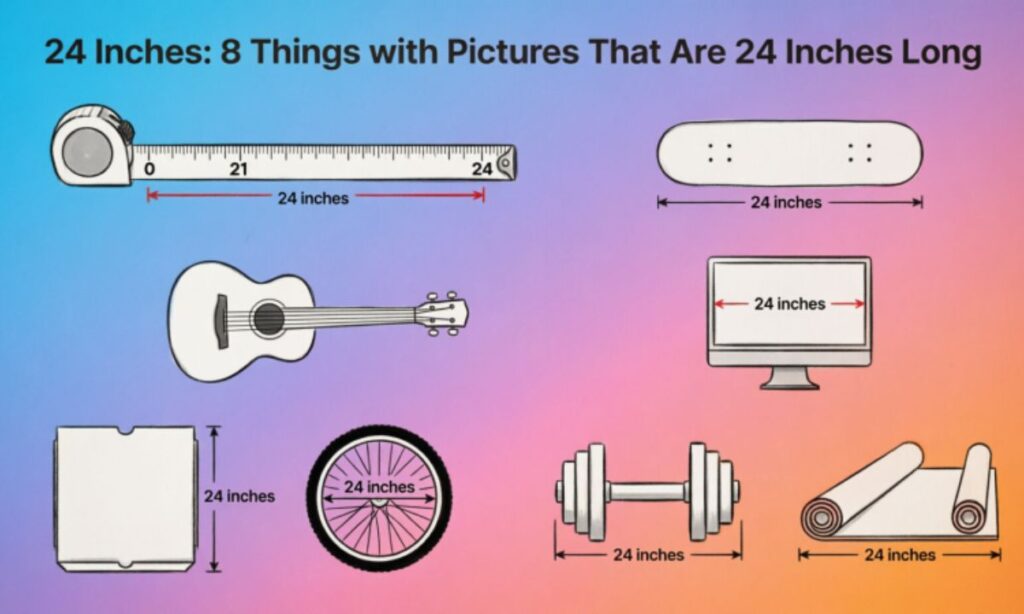

Ever grabbed a tape measure and stared at the 24-inch mark wondering what that even looks like in real life? You are not alone. Most people struggle to picture measurements without something familiar to compare them to. Good news is 24 inches is all around you, hiding in plain sight inside your home, kitchen, and garage.
24 inches equals exactly 2 feet or about 61 centimeters. That is your quick answer right there. Now let us go deeper so the next time someone asks how long 24 inches is, you can point to something right in front of you. Stick around because some of these comparisons are going to surprise you.
How Long is 24 Inches?
24 inches equals 2 feet exactly, and that conversion is dead simple since 12 inches make one foot. If you ever need to double-check, just multiply 2 by 12 and you land right back at 24. It is one of those measurements that sticks in your brain once you know it.
In the metric system, 24 inches converts to 60.96 centimeters. You get that number by multiplying 24 by 2.54, which is the standard inch-to-centimeter conversion. Most countries outside the US measure in centimeters, so knowing this conversion saves you a headache when shopping internationally.
In yards, 24 inches equals exactly two-thirds of a yard, or about 0.667 yards. This comes in handy when buying fabric, garden hose, or rope sold by the yard. Knowing that 24 inches sits at the two-thirds mark of a yardstick gives you a solid mental anchor going forward.
8 Common Things That Are 24 Inches Long
Here is where it gets interesting. These are real objects you have probably touched this week. Each one gives you a rock-solid mental picture of exactly what 24 inches looks like in everyday life. No guessing, no squinting at a ruler, just familiar things doing the measuring for you.
Standard Kitchen Cutting Board
Walk into almost any serious home kitchen and you will find a large wooden cutting board sitting on the counter. The large cutting boards used by home cooks and professional chefs typically measure around 18 by 24 inches. That 24-inch length is the long side, giving you generous prep space for chopping vegetables or breaking down a whole chicken.
If you pick up a large bamboo or hardwood cutting board at a kitchen store, chances are you are holding something that is exactly 24 inches along its longest edge. The food prep industry standardized this size because it fits comfortably on most countertops. According to USDA food safety guidelines, larger cutting boards reduce cross-contamination risks by giving you separate zones for raw meat and produce.
Next time you are in your kitchen, grab that big cutting board and flip it over. Check the dimensions on the back or the tag. You will likely see something close to 24 inches staring back at you. That board has been your silent 24-inch reference all along.
Two Rulers Placed End-to-End
This one is so simple it almost feels like cheating, but it works perfectly. Two standard 12-inch rulers lined up end to end equal exactly 24 inches, no math required. Every student and teacher already has these sitting in a desk drawer somewhere.
Each ruler represents one foot, so placing them consecutively gives you a visual representation of 2 feet instantly. This method is used in classrooms around the world to teach kids about linear measurement and unit conversion. The simplicity is the whole point.
If you want to measure something around your house and do not have a tape measure, just line up two rulers. It is accurate, free, and takes about three seconds. Honestly, it is the most underrated measurement hack out there and works on any flat surface.
Medium Pizza Box
Here is where a lot of measurement articles get things wrong. A standard large pizza from major chains typically comes in a 16 to 18-inch box, not 24 inches. However, extra-large or party-size pizzas, which many pizzerias and local shops offer, do come in boxes measuring 20 to 24 inches across.
If you have ever ordered a massive pizza for a big family gathering or a game night, that oversized square box you received was likely sitting very close to 24 inches wide. The box needs to be slightly larger than the pizza to accommodate the crust and heat-insulating padding inside. So the jumbo party pizza box is your genuine 24-inch reference.
Next time you order the biggest pizza on the menu for a crowd, take a tape measure to the box. You will likely find it lands right around that 24-inch mark. Now you have a legitimate reason to order the extra-large beyond just being hungry, which is a win.
ALSO READ:Kitchen Trash Can Dimensions: Size, Height (2026)
Small to Medium Computer Monitor (24-Inch Screen)
Walk into any electronics store and you will see 24-inch monitors everywhere. This is one of the most popular desktop screen sizes for work and gaming, and also one of the most commonly misunderstood measurements. The 24-inch number refers to the diagonal distance across the screen, not the width or height.
The actual width of a 24-inch widescreen monitor is approximately 20 to 21 inches, while the height sits around 12 to 13 inches. That diagonal corner-to-corner measurement earns it the 24-inch label. These monitors dominate the market because they hit the sweet spot between screen real estate and desk footprint.
If you are sitting at a desktop right now, look at your monitor. If it is a 24-inch screen, that diagonal is your reference point. It is one of the best ways to internalize what 24 inches looks like because you stare at it for hours every single day.
Two Standard Laptops Lined Up
Grab two average laptops and place them side by side, short edge touching short edge. The combined width comes surprisingly close to 24 inches, depending on the models. Most laptops range from 11 to 13 inches in width based on their screen size.
A 13-inch MacBook Pro measures about 11.97 inches wide. Line up two of them and you are at 23.94 inches, basically a hair under 24 inches. If you are using slightly larger 12-inch-wide laptops, two of them land you right at the 24-inch mark almost exactly.
This comparison works great for anyone in tech or anyone who works at a multi-device desk. Two laptops side by side are giving you an almost perfect 2-foot visual reference. It is a handy mental image when you need to quickly judge whether something fits on your desk or in your bag.
Baseball Bat (Youth Size)
If you have kids in Little League or have ever shopped for youth sports equipment, you have definitely handled a 24-inch baseball bat. Youth bats are sized by age and player height, and 24 inches is one of the most common lengths for players aged 5 to 7. USA Baseball recommends this length for the youngest players.
A 24-inch youth bat is lightweight, typically made from aluminum or composite materials, and designed so small players can swing it comfortably without straining. Parents shopping in the youth sports aisle will see 24-inch bats prominently displayed for the beginner age groups, right next to the helmets and batting gloves.
If you have one sitting in a garage or closet, pull it out and hold it vertically. That length from the knob at the bottom to the barrel tip is exactly 24 inches of solid, graspable measurement. It is probably one of the most satisfying ways to physically experience what 2 feet actually feels like in your hands.
Standard Mini Skateboard Deck
Skateboards are something a lot of people have around the house, and they are an underrated measurement reference. A mini or cruiser skateboard deck designed for younger riders or compact riding styles often comes in at exactly 22 to 24 inches long. These shorter decks are a real product category at any skate or sporting goods shop.
These compact boards are popular with kids learning to skate and with adults who want a pocket-sized board for short commutes. The length makes them easier to carry and maneuver, and that length sits right at our 24-inch benchmark. If you have ever picked up a mini cruiser board, you were holding something very close to 2 feet of solid maple wood.
The straight length of a mini skateboard deck gives you a clean, honest look at 24 inches because there are no curves or angles to confuse your eye. Lay it flat on the floor, step back, and you will have a crystal clear picture of what a 2-foot measurement looks like from a normal standing distance.
Standard Carry-On Luggage (Height)
Here is one every traveler knows without realizing it. Most airline carry-on suitcases are designed to meet overhead compartment limits, and the maximum allowed height across most major airlines is right around 22 to 24 inches tall. That tall slim suitcase you drag through the airport is basically a rolling 24-inch ruler.
Airlines set this limit so bags fit into overhead bins without blocking the compartment door. The 24-inch height limit is practically an industry standard, which means millions of suitcases manufactured every year are built to hit exactly this measurement. Check the tag on your carry-on. It probably says 22 or 24 inches.
This is one of the most practically useful 24-inch references because it is something you physically carry and move with your body. You feel the height of that bag when you hoist it into the overhead bin. That feeling is what 24 inches of real-world length is like when it is fighting gravity, and that memory sticks.
How to Measure 24 Inches at Home
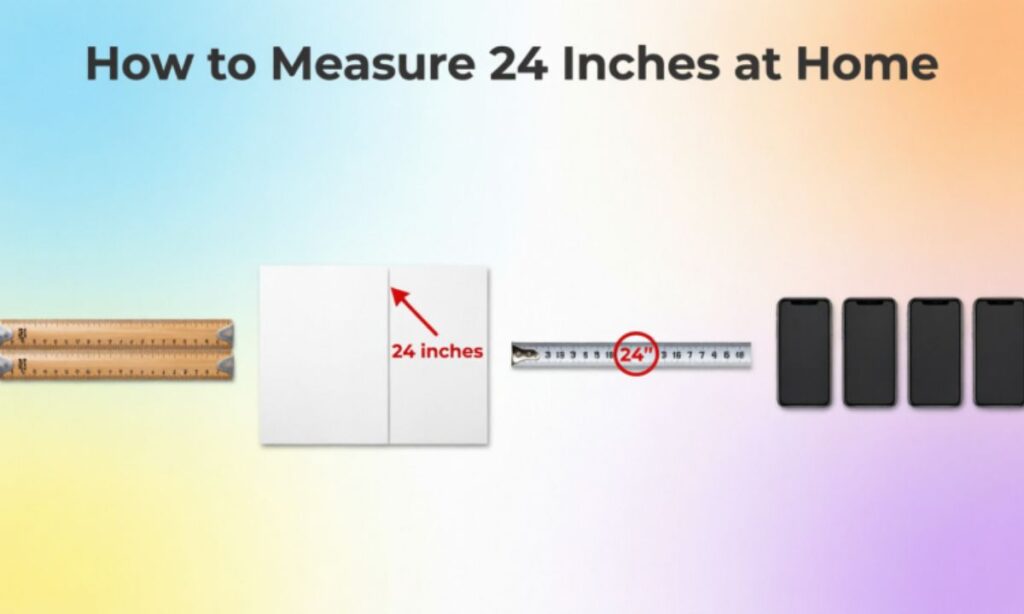
You do not always have a tape measure nearby, and that is completely fine. There are several quick and reliable ways to measure 24 inches at home using things you already have. Here are the best methods, ranked from most accurate to most creative.
• Use a tape measure. Extend it to the 24-inch or 2-foot mark. Takes five seconds and gives you a perfect result every time.
• Use two 12-inch rulers end to end. Exact 24 inches, zero math needed. Most homes have at least one ruler and many have two.
• Use a yardstick. Measure to the two-thirds mark, which lands at exactly 24 inches. Mark it with your finger or a piece of tape.
• Check your cutting board. Measure the longest edge of your large kitchen cutting board. It is very likely right at or near 24 inches.
• Use letter paper as a rough guide. Two sheets stacked lengthwise give 22 inches. Add a small spacer of about 2 inches for a rough 24-inch estimate.
A great visual trick is to remember that a standard interior door in the US is 30 to 36 inches wide. Twenty-four inches is about two-thirds of that door width. Glance at any door in your house and the left two-thirds of it is your quick mental 24-inch guide.
For home improvement projects especially, having internalized measurements like 24 inches saves real time. Contractors who know these benchmarks by feel make faster decisions and fewer costly mistakes. Knowing them is a genuine skill worth building.
Why Knowing 24 Inches Actually Matters in Real Life
You might think this is just trivia, but knowing common measurements saves real time and real money. When you are buying furniture online and the description says an item is 24 inches wide, you now have eight physical references to instantly judge whether it fits your space. That is the difference between a confident purchase and a return label.
Home improvement projects are where this knowledge really earns its keep. Knowing that 24 inches equals 2 feet lets you mentally map out shelving, counter space, tile layouts, and cabinet spacing without pulling out a ruler every five minutes. DIY homeowners who have internalized measurements like 12, 24, and 36 inches work faster.
Interior decorators and furniture arrangers also rely on these benchmarks constantly. A 24-inch gap between a sofa and a coffee table is the standard minimum for comfortable legroom. Knowing this by feel, not just by reading it, is a skill that makes any living space more functional and more comfortable to live in.
Conclusion
24 inches equals 2 feet, 60.96 centimeters, or two-thirds of a yard. Now you have eight ways to picture it without ever touching a ruler. From the large cutting board on your kitchen counter to the carry-on suitcase in your closet, these everyday objects are carrying 24 inches of length without making a big deal about it.
The youth baseball bat in your garage and the mini skateboard deck in your kids’ room are quietly living at that 2-foot mark every single day. Two laptops side by side, two rulers end to end, a 24-inch monitor you stare at for hours. It is everywhere once you know what to look for.
The next time someone asks you to eyeball 24 inches or cut something to that length without a tape measure, you are ready. Bookmark this page, share it with someone who always loses their measuring tape, and drop a comment below telling us which reference object surprised you the most. We want to hear it.