
You pick up a bag from the store and wonder how heavy it actually is. You try to calibrate your kitchen scale but have no idea what to compare it to. Sound familiar? You are not alone.
500 grams equals 0.5 kilograms or about 1.1 pounds. That is roughly 17.6 ounces if you think in imperial units. Once you link this number to everyday objects, it clicks instantly.
This guide gives you 10 real things that weigh 500 grams, plus tips on how to measure and compare this weight without any tools. No guesswork. No confusion. Just clear, honest references you can use today.
8 Everyday Things That Weigh About 500 Grams
You do not need a lab or fancy equipment to understand what 500 grams looks like. These are items sitting in your kitchen, pantry, or wallet right now. Each one gives you a solid, real-world feel for this weight.
Knowing these common 500g items saves you every time you need to estimate, ship, or cook. Some are precise. Some are close approximations. Together they build a mental picture that sticks.
A Standard Loaf of Bread
Walk into any supermarket and check the bread aisle. Most standard sliced loaves sold in metric countries are labeled at exactly 500 grams net weight. This is not a coincidence. Bakeries standardized around this number because it matches a family’s daily use.
White sandwich bread usually lands between 480 to 500 grams. Whole wheat bread tends to run slightly heavier at 510 to 530 grams because of its denser grain structure. Artisan or sourdough loaves vary more, so stick to the standard packaged sliced loaf for your reference.
This is one of the most accessible everyday items that weigh 500 grams you will ever find. Next time you grab a loaf, hold it for a second before tossing it in your cart. That weight in your hand is your 500g anchor.
A 500ml Bottle of Water (Full)
This one is not an estimate. It is pure science. Water has a density of exactly 1 gram per milliliter at room temperature, which means 500ml of water weighs precisely 500 grams every single time.
The single-serve 500ml water bottles you grab at a gas station or gym are your most reliable household scale reference. Fill one completely to the brim and you have a perfect 500g weight reference in your palm. This is also the go-to answer for calibrating a digital scale at home.
If you ever need to verify a scale’s accuracy without buying certified weights, reach for a full 500ml bottle first. It is cheap, available everywhere, and scientifically exact. Keep one handy in your kitchen and you will never be confused about this weight again.
Two Medium-Sized Apples
Grab two medium apples from your fruit bowl and hold them together. According to USDA nutrition data, a medium apple weighs approximately 182 grams on average. Two of them together come to roughly 364 grams, so pick two that feel slightly on the larger side to hit the 500g mark.
Granny Smith and Honeycrisp apples tend to run heavier, often reaching 220 to 250 grams each, which puts two of them right at 500 grams. Gala and Fuji apples are slightly smaller, so you may need to pick larger specimens. The variety matters more than people realize.
This is a great example of a daily 500g reference that also changes with season and harvest. It is not as precise as water, but it is a fantastic visual and tactile guide. Next time you are at the produce stand, pick up two apples and feel what half a kilo actually means.
A Standard Package of Pasta

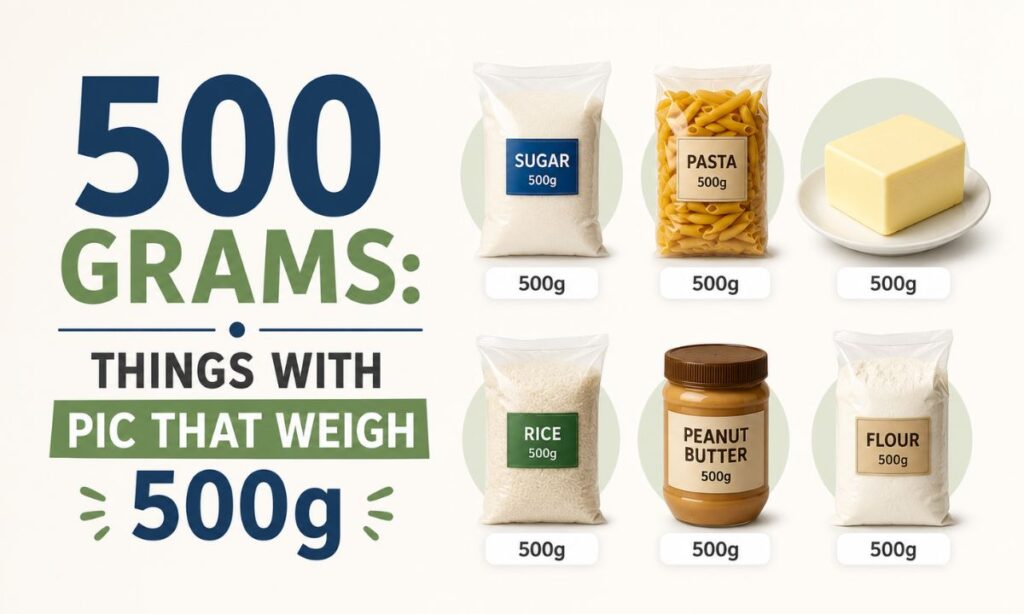
Open your pantry and look at the pasta shelf. In most European countries and increasingly in American stores, dried pasta is sold in 500-gram packages as the default size. Spaghetti, penne, rigatoni, farfalle. The shape changes but the package weight stays the same.
This specific amount was chosen because 500 grams of dry pasta feeds roughly 4 to 5 people as a main course. It lines up perfectly with a standard family dinner, which is why manufacturers locked in on this number decades ago.
Next time you cook pasta, notice the weight printed on the box before you open it. That cardboard rectangle in your hand is a perfect household item weighing 500 grams you can test anytime. Even better, it is uniform and dry, so the weight stays consistent no matter where you buy it.
Also Read:100 Grams: Things That Weigh 100 Grams (2026 Guide)
A Large Can of Soup or Vegetables
The bigger cans on grocery store shelves are another solid reference for 500 grams. Think of the large ready-to-eat soup cans, the family-size canned corn, or the big cans of diced tomatoes. These typically weigh between 480 and 540 grams total, including the metal can.
Campbell’s Chunky soup comes in an 18.8 oz can which works out to about 533 grams. That is close enough to use as a practical 500g reference object without needing a scale. The slight variation comes from the metal can weight and the density of the contents inside.
Pick up one of these cans and really feel the weight. It is heavier than it looks, which surprises most people the first time. This is one of those moderate 500g items that teaches you the weight through pure feel and repetition.
100 US Nickels
Here is the most precise non-scale method you will ever find. Each US nickel weighs exactly 5.00 grams according to official US Mint specifications. Do the math: 100 nickels multiplied by 5 grams equals exactly 500 grams.
US coin weights are federally regulated and held to extremely tight tolerances, which means your stack of 100 nickels is essentially a certified reference weight. As long as the coins are not heavily worn or damaged, they will land within a fraction of a gram of 500.
If you are trying to calibrate a kitchen or postal scale, this is your best bet short of buying official calibration weights. Gather 100 nickels, stack them carefully, and place them on your scale. If the reading is not 500 grams, your scale needs adjustment.
A Bag of Sugar or Flour (Small Package)
Check the baking aisle and look for the smaller bags. Many baking staples like sugar, flour, brown sugar, and powdered sugar come in 500-gram packages in metric markets. European and international brands especially love the 500g standard because it fits neatly into metric recipes.
In US stores you will sometimes see 454-gram packages labeled as 1 pound alongside the 500-gram options. Always check the label because the two sizes look almost identical on the shelf. The 500g bag of flour is slightly fuller and just a touch heavier than the pound bag.
Either way, these small baking packages are a real 500g object you interact with regularly. Hold one before you pour it into your mixing bowl next time you bake. That familiar bag weight is your brain’s shortcut to understanding half a kilogram without thinking twice.
A Medium-Sized Hardcover Book
Pull a hardcover off your bookshelf and feel the weight. A typical fiction hardcover with 300 to 400 pages usually lands in the 420 to 520-gram range, with most sitting right around 500 grams. Paper quality, cover thickness, and page count all shift the exact number.
Standard novels in hardcover format are a great ballpark example. They are dense enough to feel substantial but not so heavy that they strain your wrist. This is the kind of moderate weight your hands start to recognize over time.
Textbooks and glossy-paged reference books run heavier because of coated paper and reinforced spines. For your 500g weight reference, stick to standard trade hardcovers. It is not a precise tool, but it is a surprisingly consistent daily object for building weight intuition.
A Dozen Large Eggs
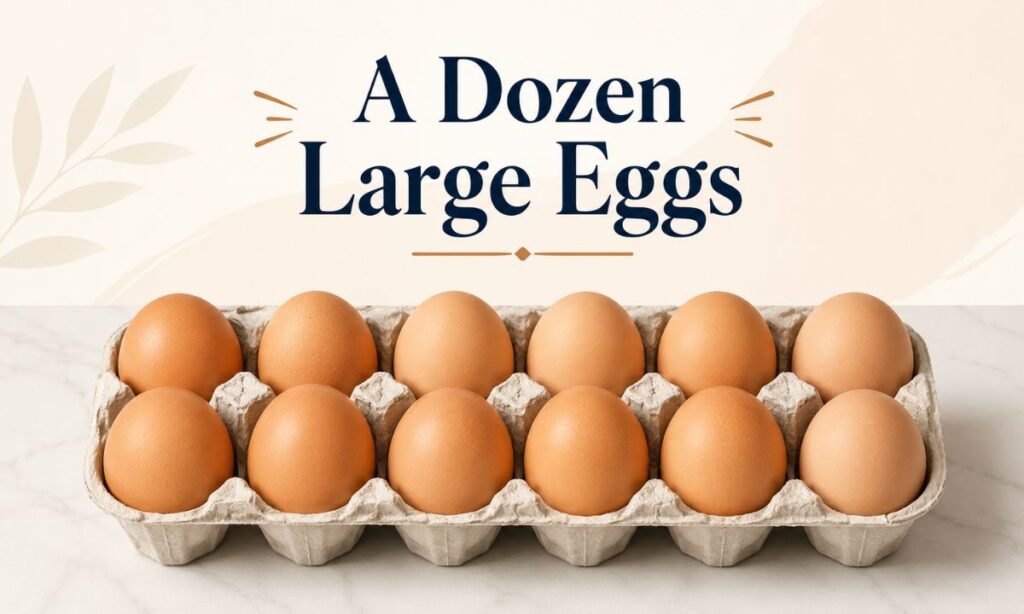
Here is one most people never think about but instantly recognize. A standard large egg in the US weighs about 50 grams according to USDA grading standards. Twelve large eggs in a carton total roughly 600 grams, but ten large eggs land right at 500 grams.
If you want a quick check, pull out your egg carton and remove two eggs. The remaining ten eggs sitting in the carton give you a very close 500-gram reference you can verify yourself. This works best with fresh, uncracked eggs still in their shells.
Eggs are something almost everyone has in their kitchen at any given time. They are consistent in weight, easy to handle, and genuinely useful for building a feel for everyday 500g objects. Next time you reach for eggs in the morning, pick up ten of them together and feel that weight.
A Small Jar of Peanut Butter
Check your pantry for a small peanut butter jar. Many single-serve or compact peanut butter jars are sold in 500-gram sizes across major brands. The glass or plastic jar adds a small amount of weight on top, but the product weight printed on the label is your guide.
Crunchy or creamy, natural or conventional, the 500g peanut butter jar is extremely common in grocery stores worldwide. It is also a satisfying weight to hold because peanut butter is dense and the jar feels solid in your hand. This makes it a great tactile 500g reference for people who learn through physical sensation.
Beyond being a weight reference, a 500g jar of peanut butter is also just a good thing to have around. It is one of those household items weighing 500 grams that pulls double duty as a snack and a scale calibration tool. Grab one next time you shop and you will always have a 500g reference in your kitchen.
How to Measure 500 Grams Without a Scale
Not everyone has a kitchen scale sitting on the counter, and that is completely fine. The objects above are your toolkit for estimating 500 grams without a scale. Start with a full 500ml water bottle as your baseline because it is scientifically exact.
Hold the water bottle in one hand and feel the weight carefully. Then pick up whatever object you want to compare with your other hand. If they feel roughly equal, you are in the 500-gram ballpark.
For greater accuracy, use the 100 US nickels method. Count out exactly 100 nickels, stack them, and use them to teach your hands what 500 grams feels like. Building weight intuition takes maybe 10 minutes of practice and it is a genuinely useful skill that most people never bother to develop.
Comparing 500 Grams to Other Common Weights
Understanding how 500 grams relates to other metric weights puts this number in context. Weight comparisons make the number feel more real because your brain processes relationships better than raw numbers. Here is how 500 grams lines up against the weights you encounter every day.
500 Grams vs. 1 Pound
This comparison trips people up constantly, especially in the US. 500 grams does not equal 1 pound. One pound equals exactly 454 grams. So 500 grams is actually 46 grams heavier than a pound, which works out to roughly 1.1 pounds.
The confusion happens because food is often sold in both 454g and 500g packages and they look identical on the shelf. When a recipe says 1 pound and you only have a 500g package, you are adding about 10 percent more than the recipe calls for.
500 grams in pounds is 1.102 pounds if you want the precise number. In ounces, that converts to 17.64 ounces. Keep this conversion in your back pocket whenever you switch between metric and imperial measurements.
How 500 Grams Relates to Other Metric Weights
500 grams is exactly half a kilogram, which makes it one of the cleanest metric reference points you can use. Knowing this instantly tells you that two standard pasta packages equal 1 kilogram, or that four medium apples are approximately 1 kilogram.
250 grams is half of 500 grams, which is one medium apple, half a pasta package, or 50 US nickels. Many individual snack and single-serve food packages are designed around this weight. It is the quarter kilogram mark.
100 grams is one-fifth of 500 grams, and this is the weight nutrition labels love. Most food labels list their nutritional information per 100 gram serving because it makes comparison easy. A bar of soap or a medium banana weighs close to 100 grams.
1 kilogram is double 500 grams, or about 2.2 pounds. Once you feel 500 grams confidently, doubling that sensation gives you an instant feel for a full kilogram weight reference too.
Quick Reference Table: Things That Weigh 500 Grams
| Object | Weight | Precision |
| Full 500ml water bottle | Exactly 500g | Very High |
| 100 US nickels | Exactly 500g | Very High |
| Standard pasta package | 500g | High |
| Small bag of sugar or flour | 500g | High |
| Standard loaf of bread | 480 to 530g | Medium |
| Large can of soup | 480 to 540g | Medium |
| Two medium-large apples | 440 to 500g | Medium |
| Medium hardcover book | 420 to 520g | Medium |
| Ten large eggs | 480 to 510g | Medium |
| Small jar of peanut butter | 500g | High |
Frequently Asked Questions
What is something that weighs 500 grams? A full 500ml water bottle weighs exactly 500 grams. A standard pasta package, a small bag of flour, and 100 US nickels are also accurate 500-gram reference objects you likely already own.
What weighs 500 grams to calibrate my scale? Use 100 US nickels. Each nickel weighs exactly 5 grams per US Mint specifications, so 100 nickels equal exactly 500 grams. A completely full 500ml water bottle is equally precise.
Does 500g equal 1 pound? No. One pound equals 454 grams. So 500 grams is approximately 1.1 pounds, which is about 46 grams heavier than a single pound.
How many nickels make 500 grams? Exactly 100 nickels. Each US nickel weighs precisely 5.00 grams, making this the most precise household method for measuring 500 grams without a certified scale.
What does 500 grams of food look like? Visually, it looks like a standard loaf of bread, a full single-serve water bottle, or a small jar of peanut butter. It is a satisfying handful, heavier than it looks to most people the first time.
Conclusion
Understanding what weighs 500 grams is one of those small pieces of knowledge that keeps coming in handy. Whether you are calibrating a scale, estimating shipping costs, or just building your feel for metric weights, these ten objects give you a toolkit you can use anywhere.
Start with the 500ml water bottle because it is exact and always available. Add the 100 nickels method for moments when you need real precision. Then let the bread, pasta, and peanut butter jar reinforce that feeling every time you handle them in daily life.
Weight intuition is a skill, and like any skill it gets sharper the more you practice. Hold these objects deliberately a few times, pay attention to the sensation, and your hands will start recognizing half a kilogram without even thinking about it. Got a favorite object that weighs 500 grams we missed? Drop it in the comments.
500 Grams: Things with Pic That Weigh 500g
You pick up a bag from the store and wonder how heavy it actually is. You try to calibrate your kitchen scale but have no idea what to compare it to. Sound familiar? You are not alone.
500 grams equals 0.5 kilograms or about 1.1 pounds. That is roughly 17.6 ounces if you think in imperial units. Once you link this number to everyday objects, it clicks instantly.
This guide gives you 10 real things that weigh 500 grams, plus tips on how to measure and compare this weight without any tools. No guesswork. No confusion. Just clear, honest references you can use today.
8 Everyday Things That Weigh About 500 Grams
You do not need a lab or fancy equipment to understand what 500 grams looks like. These are items sitting in your kitchen, pantry, or wallet right now. Each one gives you a solid, real-world feel for this weight.
Knowing these common 500g items saves you every time you need to estimate, ship, or cook. Some are precise. Some are close approximations. Together they build a mental picture that sticks.
A Standard Loaf of Bread
Walk into any supermarket and check the bread aisle. Most standard sliced loaves sold in metric countries are labeled at exactly 500 grams net weight. This is not a coincidence. Bakeries standardized around this number because it matches a family’s daily use.
White sandwich bread usually lands between 480 to 500 grams. Whole wheat bread tends to run slightly heavier at 510 to 530 grams because of its denser grain structure. Artisan or sourdough loaves vary more, so stick to the standard packaged sliced loaf for your reference.
This is one of the most accessible everyday items that weigh 500 grams you will ever find. Next time you grab a loaf, hold it for a second before tossing it in your cart. That weight in your hand is your 500g anchor.
A 500ml Bottle of Water (Full)
This one is not an estimate. It is pure science. Water has a density of exactly 1 gram per milliliter at room temperature, which means 500ml of water weighs precisely 500 grams every single time.
The single-serve 500ml water bottles you grab at a gas station or gym are your most reliable household scale reference. Fill one completely to the brim and you have a perfect 500g weight reference in your palm. This is also the go-to answer for calibrating a digital scale at home.
If you ever need to verify a scale’s accuracy without buying certified weights, reach for a full 500ml bottle first. It is cheap, available everywhere, and scientifically exact. Keep one handy in your kitchen and you will never be confused about this weight again.
Two Medium-Sized Apples
Grab two medium apples from your fruit bowl and hold them together. According to USDA nutrition data, a medium apple weighs approximately 182 grams on average. Two of them together come to roughly 364 grams, so pick two that feel slightly on the larger side to hit the 500g mark.
Granny Smith and Honeycrisp apples tend to run heavier, often reaching 220 to 250 grams each, which puts two of them right at 500 grams. Gala and Fuji apples are slightly smaller, so you may need to pick larger specimens. The variety matters more than people realize.
This is a great example of a daily 500g reference that also changes with season and harvest. It is not as precise as water, but it is a fantastic visual and tactile guide. Next time you are at the produce stand, pick up two apples and feel what half a kilo actually means.
A Standard Package of Pasta
Open your pantry and look at the pasta shelf. In most European countries and increasingly in American stores, dried pasta is sold in 500-gram packages as the default size. Spaghetti, penne, rigatoni, farfalle. The shape changes but the package weight stays the same.
This specific amount was chosen because 500 grams of dry pasta feeds roughly 4 to 5 people as a main course. It lines up perfectly with a standard family dinner, which is why manufacturers locked in on this number decades ago.
Next time you cook pasta, notice the weight printed on the box before you open it. That cardboard rectangle in your hand is a perfect household item weighing 500 grams you can test anytime. Even better, it is uniform and dry, so the weight stays consistent no matter where you buy it.
A Large Can of Soup or Vegetables
The bigger cans on grocery store shelves are another solid reference for 500 grams. Think of the large ready-to-eat soup cans, the family-size canned corn, or the big cans of diced tomatoes. These typically weigh between 480 and 540 grams total, including the metal can.
Campbell’s Chunky soup comes in an 18.8 oz can which works out to about 533 grams. That is close enough to use as a practical 500g reference object without needing a scale. The slight variation comes from the metal can weight and the density of the contents inside.
Pick up one of these cans and really feel the weight. It is heavier than it looks, which surprises most people the first time. This is one of those moderate 500g items that teaches you the weight through pure feel and repetition.
100 US Nickels
Here is the most precise non-scale method you will ever find. Each US nickel weighs exactly 5.00 grams according to official US Mint specifications. Do the math: 100 nickels multiplied by 5 grams equals exactly 500 grams.
US coin weights are federally regulated and held to extremely tight tolerances, which means your stack of 100 nickels is essentially a certified reference weight. As long as the coins are not heavily worn or damaged, they will land within a fraction of a gram of 500.
If you are trying to calibrate a kitchen or postal scale, this is your best bet short of buying official calibration weights. Gather 100 nickels, stack them carefully, and place them on your scale. If the reading is not 500 grams, your scale needs adjustment.
A Bag of Sugar or Flour (Small Package)
Check the baking aisle and look for the smaller bags. Many baking staples like sugar, flour, brown sugar, and powdered sugar come in 500-gram packages in metric markets. European and international brands especially love the 500g standard because it fits neatly into metric recipes.
In US stores you will sometimes see 454-gram packages labeled as 1 pound alongside the 500-gram options. Always check the label because the two sizes look almost identical on the shelf. The 500g bag of flour is slightly fuller and just a touch heavier than the pound bag.
Either way, these small baking packages are a real 500g object you interact with regularly. Hold one before you pour it into your mixing bowl next time you bake. That familiar bag weight is your brain’s shortcut to understanding half a kilogram without thinking twice.
A Medium-Sized Hardcover Book
Pull a hardcover off your bookshelf and feel the weight. A typical fiction hardcover with 300 to 400 pages usually lands in the 420 to 520-gram range, with most sitting right around 500 grams. Paper quality, cover thickness, and page count all shift the exact number.
Standard novels in hardcover format are a great ballpark example. They are dense enough to feel substantial but not so heavy that they strain your wrist. This is the kind of moderate weight your hands start to recognize over time.
Textbooks and glossy-paged reference books run heavier because of coated paper and reinforced spines. For your 500g weight reference, stick to standard trade hardcovers. It is not a precise tool, but it is a surprisingly consistent daily object for building weight intuition.
A Dozen Large Eggs
Here is one most people never think about but instantly recognize. A standard large egg in the US weighs about 50 grams according to USDA grading standards. Twelve large eggs in a carton total roughly 600 grams, but ten large eggs land right at 500 grams.
If you want a quick check, pull out your egg carton and remove two eggs. The remaining ten eggs sitting in the carton give you a very close 500-gram reference you can verify yourself. This works best with fresh, uncracked eggs still in their shells.
Eggs are something almost everyone has in their kitchen at any given time. They are consistent in weight, easy to handle, and genuinely useful for building a feel for everyday 500g objects. Next time you reach for eggs in the morning, pick up ten of them together and feel that weight.
A Small Jar of Peanut Butter
Check your pantry for a small peanut butter jar. Many single-serve or compact peanut butter jars are sold in 500-gram sizes across major brands. The glass or plastic jar adds a small amount of weight on top, but the product weight printed on the label is your guide.
Crunchy or creamy, natural or conventional, the 500g peanut butter jar is extremely common in grocery stores worldwide. It is also a satisfying weight to hold because peanut butter is dense and the jar feels solid in your hand. This makes it a great tactile 500g reference for people who learn through physical sensation.
Beyond being a weight reference, a 500g jar of peanut butter is also just a good thing to have around. It is one of those household items weighing 500 grams that pulls double duty as a snack and a scale calibration tool. Grab one next time you shop and you will always have a 500g reference in your kitchen.
How to Measure 500 Grams Without a Scale
Not everyone has a kitchen scale sitting on the counter, and that is completely fine. The objects above are your toolkit for estimating 500 grams without a scale. Start with a full 500ml water bottle as your baseline because it is scientifically exact.
Hold the water bottle in one hand and feel the weight carefully. Then pick up whatever object you want to compare with your other hand. If they feel roughly equal, you are in the 500-gram ballpark.
For greater accuracy, use the 100 US nickels method. Count out exactly 100 nickels, stack them, and use them to teach your hands what 500 grams feels like. Building weight intuition takes maybe 10 minutes of practice and it is a genuinely useful skill that most people never bother to develop.
Comparing 500 Grams to Other Common Weights
Understanding how 500 grams relates to other metric weights puts this number in context. Weight comparisons make the number feel more real because your brain processes relationships better than raw numbers. Here is how 500 grams lines up against the weights you encounter every day.
500 Grams vs. 1 Pound
This comparison trips people up constantly, especially in the US. 500 grams does not equal 1 pound. One pound equals exactly 454 grams. So 500 grams is actually 46 grams heavier than a pound, which works out to roughly 1.1 pounds.
The confusion happens because food is often sold in both 454g and 500g packages and they look identical on the shelf. When a recipe says 1 pound and you only have a 500g package, you are adding about 10 percent more than the recipe calls for.
500 grams in pounds is 1.102 pounds if you want the precise number. In ounces, that converts to 17.64 ounces. Keep this conversion in your back pocket whenever you switch between metric and imperial measurements.
How 500 Grams Relates to Other Metric Weights
500 grams is exactly half a kilogram, which makes it one of the cleanest metric reference points you can use. Knowing this instantly tells you that two standard pasta packages equal 1 kilogram, or that four medium apples are approximately 1 kilogram.
250 grams is half of 500 grams, which is one medium apple, half a pasta package, or 50 US nickels. Many individual snack and single-serve food packages are designed around this weight. It is the quarter kilogram mark.
100 grams is one-fifth of 500 grams, and this is the weight nutrition labels love. Most food labels list their nutritional information per 100 gram serving because it makes comparison easy. A bar of soap or a medium banana weighs close to 100 grams.
1 kilogram is double 500 grams, or about 2.2 pounds. Once you feel 500 grams confidently, doubling that sensation gives you an instant feel for a full kilogram weight reference too.
Quick Reference Table: Things That Weigh 500 Grams
| Object | Weight | Precision |
| Full 500ml water bottle | Exactly 500g | Very High |
| 100 US nickels | Exactly 500g | Very High |
| Standard pasta package | 500g | High |
| Small bag of sugar or flour | 500g | High |
| Standard loaf of bread | 480 to 530g | Medium |
| Large can of soup | 480 to 540g | Medium |
| Two medium-large apples | 440 to 500g | Medium |
| Medium hardcover book | 420 to 520g | Medium |
| Ten large eggs | 480 to 510g | Medium |
| Small jar of peanut butter | 500g | High |
Frequently Asked Questions
What is something that weighs 500 grams? A full 500ml water bottle weighs exactly 500 grams. A standard pasta package, a small bag of flour, and 100 US nickels are also accurate 500-gram reference objects you likely already own.
What weighs 500 grams to calibrate my scale? Use 100 US nickels. Each nickel weighs exactly 5 grams per US Mint specifications, so 100 nickels equal exactly 500 grams. A completely full 500ml water bottle is equally precise.
Does 500g equal 1 pound? No. One pound equals 454 grams. So 500 grams is approximately 1.1 pounds, which is about 46 grams heavier than a single pound.
How many nickels make 500 grams? Exactly 100 nickels. Each US nickel weighs precisely 5.00 grams, making this the most precise household method for measuring 500 grams without a certified scale.
What does 500 grams of food look like? Visually, it looks like a standard loaf of bread, a full single-serve water bottle, or a small jar of peanut butter. It is a satisfying handful, heavier than it looks to most people the first time.
Conclusion
Understanding what weighs 500 grams is one of those small pieces of knowledge that keeps coming in handy. Whether you are calibrating a scale, estimating shipping costs, or just building your feel for metric weights, these ten objects give you a toolkit you can use anywhere.
Start with the 500ml water bottle because it is exact and always available. Add the 100 nickels method for moments when you need real precision. Then let the bread, pasta, and peanut butter jar reinforce that feeling every time you handle them in daily life.
Weight intuition is a skill, and like any skill it gets sharper the more you practice. Hold these objects deliberately a few times, pay attention to the sensation, and your hands will start recognizing half a kilogram without even thinking about it. Got a favorite object that weighs 500 grams we missed? Drop it in the comments.