
You are in the middle of cooking and the recipe says
2 ounces but you have no scale nearby. Sound familiar? That happens to almost everyone at some point.
Quick answer: 2 oz equals 1/4 cup, 4 tablespoons, 59 mL, and 56.7 grams. Keep reading and you will never guess wrong on this measurement again.
What Is 2 Ounces?
An ounce is a unit in the US customary system of measurement, and it shows up constantly in everyday life.
You see it on food labels, medicine bottles, cocktail recipes, and shipping packages. But there are actually two completely different types of ounces, and mixing them up causes real problems.
Fluid ounces (fl oz) measure volume, think water, juice, milk, or any pourable liquid. Dry ounces measure weight, think flour, sugar, chocolate chips, or ground coffee. Always check which type a recipe is calling for before you measure anything.
How Much Is 2 Ounces in Cups, Grams, mL and More
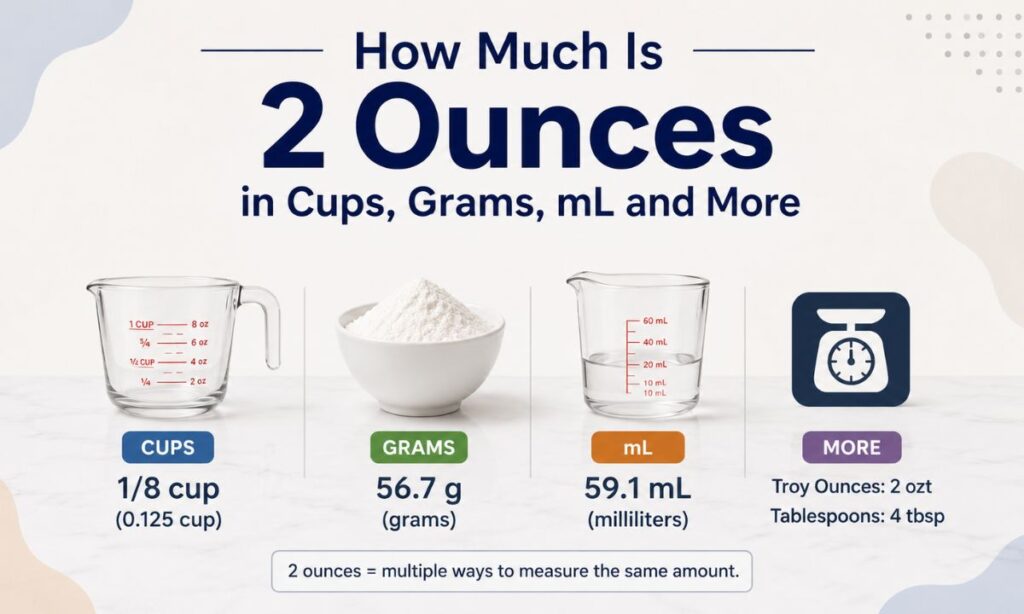
This is the section most people come here for, so let’s get straight to it. 2 ounce conversion shows up in baking, dieting, bartending, and even travel packing all the time.
How Much Is 2 Ounces in Cups?
2 fluid ounces equals exactly 1/4 cup in the US standard measuring system.
This is one of the most reached-for measurements in home baking, especially for vanilla extract, salad dressing, or small sauce portions.
If your measuring cup has lines on it, the 1/4 cup mark is your 2 oz target. Just fill it up to that line and you have exactly 2 oz of liquid. No scale, no guessing, no stress.
How Much Is 2 oz in mL?
2 fluid ounces equals approximately 59.15 mL, which you will often see rounded to 59 mL.
This comes up in espresso measurements, medicine cups, and small cocktail pours constantly. A lot of people confuse this: 30 mL is 1 oz, and 100 mL is about 3.4 oz, not 2.
If you are following a metric recipe from outside the US, this 2 oz to mL conversion is the one to bookmark. Most digital kitchen scales and medicine cups show mL markings so this is easy to confirm.
How Much Is 2 Ounces in Grams?
2 ounces equals 56.7 grams, and the formula is simple: multiply ounces by 28.35.
This matters most when you are buying ingredients labeled in metric units or following international recipes. European and Asian recipes almost always use grams, so this conversion saves a lot of confusion.
Knowing 2 oz in grams also helps when tracking food portions or following a specific diet plan. Round it to 57 grams and you will never be far off.
How Much Is 2 Ounces in Tablespoons?
2 oz equals 4 tablespoons when you are measuring liquids.
One fluid ounce always equals 2 tablespoons in the US system, so 2 oz doubles that. This is one of the most common measuring mistakes, thinking 2 oz is 2 tablespoons when it is actually double that amount.
The 2 oz to tablespoons conversion is super handy for measuring butter, honey, nut butter, and thick sauces. Just grab your tablespoon and fill it four times level and you have your 2 oz.
Also Read:Beverage Can Dimensions: Size, Height (2026)
Quick 2 Ounces Conversion Reference Table
| Measurement | Equivalent | Best Used For |
| 2 oz to Cups | 1/4 cup | Baking, cooking |
| 2 oz to Tablespoons | 4 tablespoons | Butter, sauces, spreads |
| 2 oz to Milliliters | 59.15 mL | Liquids, drinks, medicine |
| 2 oz to Grams | 56.7 grams | Dry ingredients, food labels |
| 2 oz to Pounds | 1/8 lb | Shipping, food packaging |
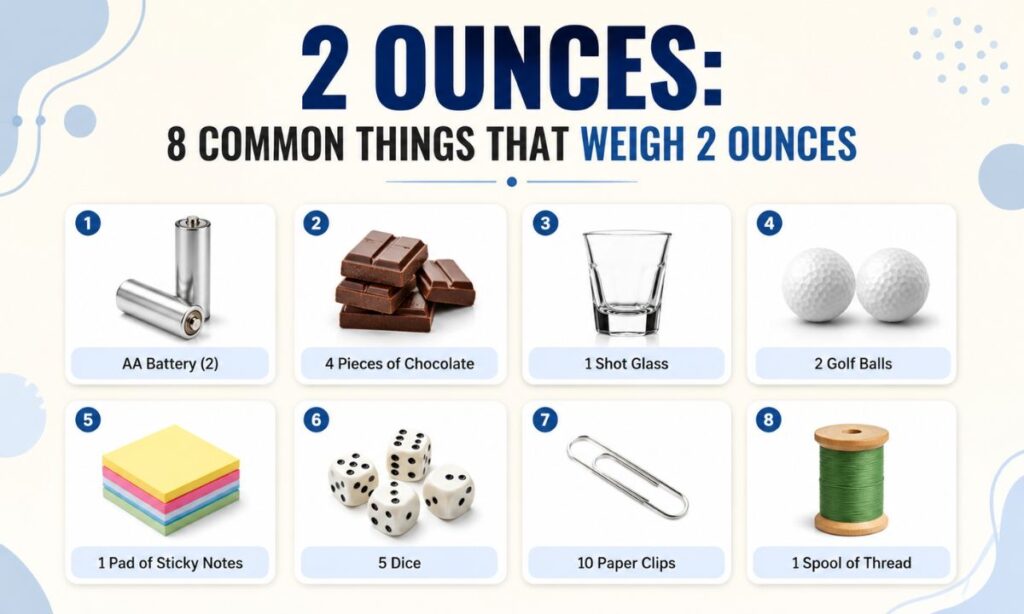
8 Most Common Things That Weigh 2 Ounces
Instead of hunting for a scale, you can grab one of these everyday objects to get your 2 oz reference instantly. Each has been selected because it is consistent, easy to find, and genuinely reliable.
One Large Egg
According to the USDA, a large egg weighs approximately 56 to 57 grams, which lands right at 2 ounces.
It is the single most reliable kitchen reference for this weight that exists in almost every home. Pick one up right now and feel that weight in your hand. That is exactly 2 oz.
Every grocery store sells them, every kitchen has them, and the weight is consistent across brands. When someone asks what 2 ounces feels like, the egg is your best answer.
Two AA Batteries
Two standard AA batteries together weigh approximately 46 to 50 grams combined, which is close to but slightly under 2 oz (56.7g).
They are a useful ballpark reference, just not a precise one, because battery brands and chemistries vary slightly. Think of two AAs as your ‘almost 2 oz’ check, great for rough estimates.
Pick up two Duracell or Energizer AAs and you get a quick feel for what just under 2 oz is like. If you need exact, go with the egg or the pennies method instead.
A Standard Deck of Playing Cards
A standard 52-card deck typically weighs between 80 and 100 grams depending on card stock and brand. That is closer to 3 to 3.5 oz, so use this as a visual size reference more than a precise weight check.
Teachers and postal workers sometimes use a card deck to visualize small object weight references. Just know that for exact 2 oz needs, the egg or pennies are more accurate.
The deck is a great size anchor, not a weight anchor. It still helps you visualize the general category of lightweight small objects.
A Small Lemon or Kiwi
A very small lemon, one of the tiny ones at the bottom of the bin, weighs roughly 50 to 60 grams. A single kiwi from the grocery store falls right in the same range.
Both give you a solid, hands-on feel for what 2 oz of food weight looks like. Next time you are at the store, grab the smallest lemon you can find.
That lightweight, barely-there feel in your palm? That is your 2 oz food portion reference. It is especially useful for visualizing small ingredient amounts in salads or garnishes.
Twenty-Two US Pennies
Each US penny weighs exactly 2.5 grams according to the US Mint. Stack 22 pennies and you get 55 grams, just barely under 2 dry ounces (56.7g).
The 22-penny method is the most accurate no-scale DIY approach for dry ingredients. Count 22 cents from your pocket and you have a measuring tool sitting right there.
It is the kind of kitchen hack that sounds weird until you try it and it works perfectly. Use it as a DIY balance scale reference by placing your ingredient on one side and your penny stack on the other.
A Standard Shot Glass of Liquid
A standard US shot glass holds 1.5 fl oz. Fill it to just slightly above the rim and you get close to 2 fluid ounces.
This is the go-to shortcut for bartenders and home cocktail makers measuring liquid extracts or bitters. For more accuracy in baking or medicine dosing, use a jigger, which has a 2 fl oz side built right in.
Keep one jigger in your kitchen drawer and you will thank yourself constantly. The shot glass liquid measurement works for rough estimates but the jigger is better when precision matters.
A Stack of 10 to 12 Sugar Packets
A standard restaurant sugar packet weighs about 4 to 6 grams depending on the brand. Ten to twelve packets stacked together land very close to 56 grams, your 2 oz dry weight.
They are uniform, easy to count, and sitting on nearly every cafe table and hotel breakfast station. This is a great travel hack when you need to estimate 2 oz and have no tools at all.
Count out 11 average-size packets and you are right in the zone. It sounds silly but it is accurate enough for rough measurements when you are traveling or in a pinch.
A Full Standard Matchbox
A standard small matchbox with matches inside weighs approximately 40 to 60 grams depending on size and fullness.
A full standard-size matchbox from most brands hits very close to the 56.7 gram mark. It is compact, universally available, and a surprisingly accurate 2 ounces comparison object.
You will find matchboxes in camping gear, kitchen drawers, and most convenience stores. Pair it with the egg reference and you have two rock-solid mental anchors for this measurement.
2 Ounces of Liquid vs Dry — What Is the Real Difference?
This is where most people get tripped up and it causes actual recipe failures. 2 fl oz of water fills exactly to the 1/4 cup line on a liquid measuring cup and weighs about 59 grams.
But 2 dry oz of flour will look completely different in that same cup because flour is far less dense than water. The tools matter just as much as the numbers here.
Always use a liquid measuring cup for fluid ounces and a dry measuring cup or kitchen scale for dry ounces. This one habit alone will prevent most measuring mistakes you ever make in the kitchen.
| Type | 2 oz Example | Right Tool to Use |
| Fluid oz (volume) | 2 oz water = 59 mL | Liquid measuring cup |
| Dry oz (weight) | 2 oz flour does not equal 1/4 cup by volume | Kitchen scale or dry measuring cup |
How to Measure 2 Ounces Without a Scale
No scale? No problem at all. There are at least five reliable ways to hit 2 oz accurately using things already in your kitchen.
Pick whichever method matches what you have on hand right now. Each one works well when done carefully and consistently.
Using Measuring Cups
Pour your liquid into a measuring cup until it hits the 1/4 cup line, which equals exactly 2 fl oz.
Always check the measurement at eye level. Looking at it from above creates a parallax error and you will overpour every time.
Get down to the counter level and look straight at the line from the side. Takes two seconds and gives you a very accurate 2 oz liquid measurement.
Using Tablespoons
Count out exactly 4 level tablespoons for your ingredient. This works for liquids, thick sauces, nut butter, sour cream, honey, or any semi-solid.
Level means flat across the top, not heaped or pressed down. The tablespoon method for measuring ounces is great when you want to avoid washing a measuring cup.
It is just as accurate as the cup method when done carefully. Four level tablespoons and you are done.
How to Measure 2 Ounces of Chocolate Chips
Use a 1/4 cup dry measuring cup and fill it level without shaking or pressing down. Pressing packs the chips tighter and throws off the measurement.
Just scoop, level off the top with a straight edge, and you have your 2 oz. This same method works for measuring raisins, nuts, and small candies by volume.
It is not as precise as a scale but it is accurate enough for most baking recipes. The key is always keeping it level and never packing the cup down.
Using a Shot Glass
Fill a standard 1.5 oz shot glass just barely above the rim for approximately 2 fl oz. This is a rough but practical method for extracts, bitters, liquor, or any small liquid pour.
For more precision in baking or medicine use, a jigger with a 2 oz side is the smarter choice. The shot glass shortcut is best when you need a quick ballpark.
Bartenders use it daily and it works well in that context. Just do not rely on it for anything where exact dosing really matters.
The 22-Penny Method
Stack exactly 22 US pennies. Each penny weighs 2.5 grams per the US Mint, so 22 pennies equals 55 grams.
That is just 1.7 grams under the target of 56.7 grams, a margin of about 3 percent. Use this as a DIY balance scale reference by placing your ingredient on one side and your penny stack on the other.
This works surprisingly well for dry ingredients like spices, coffee, or small snack portions. It sounds like a silly trick until it saves your recipe at 10 PM with no scale in sight.
Why Getting 2 Ounces Right Actually Matters
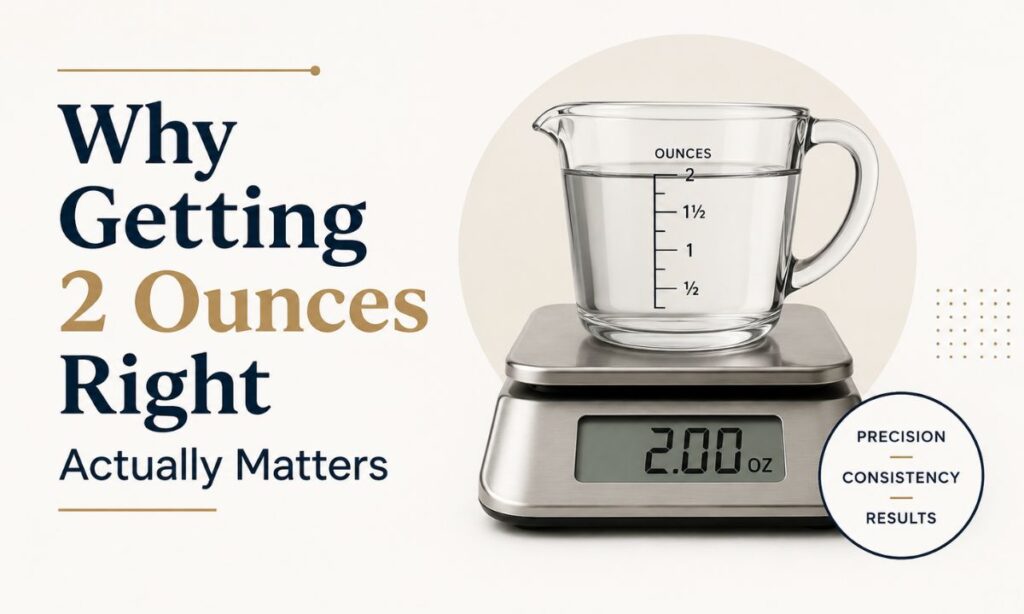
A lot of people think being a gram or two off does not matter. For casual cooking it often does not, but for baking, medicine, and cocktail mixing it absolutely can.
Baking is chemistry and the ratios are designed to work together. A slightly overloaded tablespoon of baking soda or too much vanilla extract changes the whole result. Getting precise 2 oz measurements right protects the flavor, texture, and effectiveness of whatever you are making.
The good news is that the methods in this article are easy, fast, and accurate enough for almost every situation. Consistent measuring is the habit that separates good cooks from great ones.
Conclusion
Now you know exactly what 2 ounces looks like, feels like, and equals in every unit that matters.
From cups and grams to mL and tablespoons, plus eight real objects you can grab right now for an instant reference. That large egg in your fridge? Exactly 2 oz. Those 22 pennies on your desk? Almost spot on.Drop a comment below if you found a new trick here or have your own 2 oz hack. Sharing helps other home cooks who are stuck in the same situation right now. And if this helped you, pass it along to someone who is always second-guessing their measurements in the kitchen.